Carolyn Fedigan
Fractional CHRO


What ant colonies reveal about building resilient, accountable, and high-performing teams.
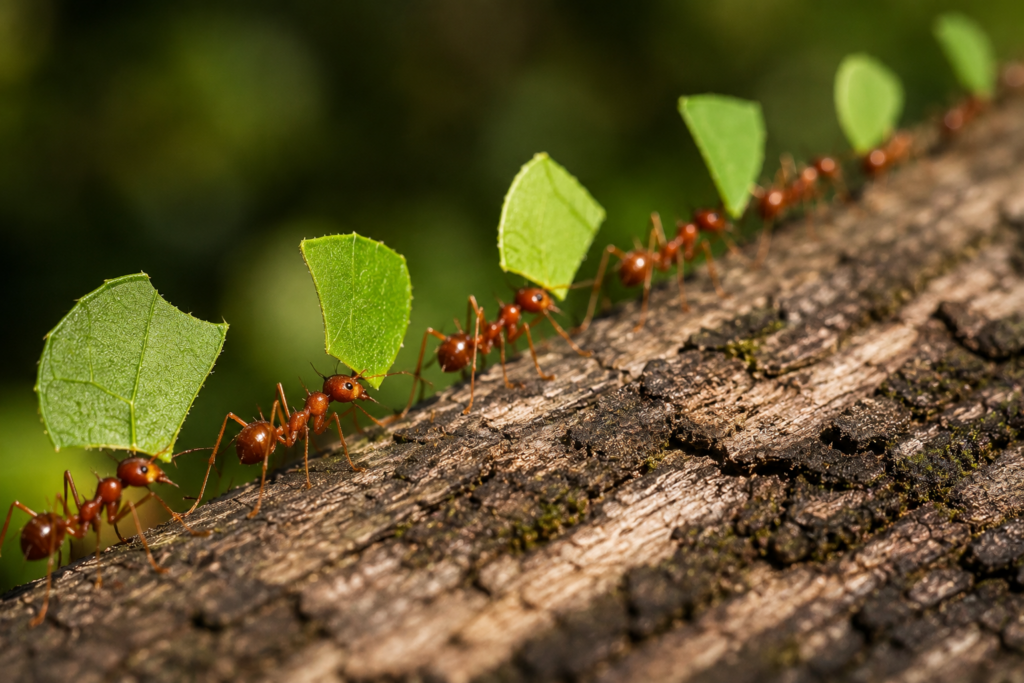
Most people find ants annoying. They eat your food on picnics, sneak into your kitchen, scurry around a piece of dropped candy. But I find myself endlessly curious about ants and anthills. I wonder how they coordinate without talking, who is the leader, how can they carry so much, and why do they run in a single file? Today, I’m in awe of the industriousness and organization of these tiny creatures. I watch anthills with hundreds of ants scurrying around, moving in single file, everyone with a job to do.
How do creatures that are so tiny know the rules of the group, the tasks to do, the goals ahead of them, and what motivates them to get in line?
For every human on Earth, there are estimated to be about 2.5 million ants per person, or 20 quadrillion in total. This is a staggering number of tiny team members, carrying out vital tasks for our ecosystem on almost every continent. Fun fact: the number of ants on Earth has a mass greater than all birds and mammals combined. I think we can learn from these little guys, who have been studied by researchers all over the world and anthropomorphized in movies (think Antz).
I have been in many groups and observed many teams during my career as a full-time and fractional CHRO. I have both led and been a participant on teams, seen teams run like well-oiled machines and others that crash and burn. Strong leaders are an important element, of course, but I like to focus on the members of the team as the most critical aspect and predictor of achievement. Success often rests on the individual members: how well they understand the goals of the team, how clear they are about their own role, how much they trust the people around them, and the ownership they feel for the outcome.
In the ant world, there are different jobs (are there job descriptions?) with remarkably clear roles:
The comparison to human teams seems pretty clear to me. People need to understand their specific responsibilities and how their contributions support the broader organization objectives.
A great team doesn’t require a leader to tell everyone what to do every minute. In fact, if that is happening, something is probably wrong. The best teams I have seen have people who understand their jobs, know the goal, trust the other members to do their part, and step in when something needs to be done. The leader may set direction, but the team makes it happen.
We tend to think more communication is better, but ants make me realize that clear communication (and not necessarily verbal) is what really matters, with everyone taking ownership. I have learned that ants communicate mostly through scent, known as pheromones, but there are some species that use other, more sophisticated means of getting their messages across. Some communicate through an antennal code, and some communicate acoustically, producing sounds with parts of their bodies.
Among these many ways of communicating, the important thing is that thousands of ants can send messages that the others understand and can act upon. They communicate to find food supplies, sense danger, defend the anthill, strengthen a trail, or summon more ants when help is needed.
Effective communication within high-performing teams requires clarity and relevance instead of sheer volume as each member plays their part toward the overall goal. The message needs to reach the right members of the team at the right time, mean the same thing to everyone, and tell people enough to know what to do next.
Maybe good teams don’t need more meetings or Slack channels, just better pheromones.
In answer to my question about whether ants sleep, researchers give a resounding yes! Unlike those of us who like a full night’s sleep, ants take hundreds of micro-naps a day, staggered so that most of the colony is awake at any one time. This means that the colony is protected and productive most of the time.
Is there something we can take away from this?
In any anthill, there are very active ants and those that appear dormant. When researchers removed the most active ants from a colony, the “idle” ants stepped up and took over their tasks. What looked like laziness may actually have been redundancy, a reserve capacity built into the team.
In my role as fractional CHRO, I often see organizations that don’t appreciate the value of reserve capacity or redundant roles. Instead, they favor “high utilization” (productivity!) over the redundancy that contributes to long-term stability. We tend to celebrate the busiest person, the employee who works the longest hours, or the person everyone depends upon. But maybe having one indispensable person isn’t evidence of a strong team. Maybe it is evidence of a vulnerable one.
There is another lesson here about teamwork: the job belongs to the colony, not to the individual ant. If someone can’t do it, someone else seamlessly steps in. There isn’t much room for “that’s not my job” when the survival of the anthill is at stake.
One of my favorite facts about ants is that some species will make a raft out of their own bodies during a flood. They link themselves together, protect the queen and the young, and literally float as a colony until they reach dry land. Individual ants take on different roles because the goal has changed from gathering food to surviving a flood. This may be the ultimate team-building exercise.
Similarly, when organizational conditions change, high-performing teams adapt and pivot without waiting for an updated job description. The strongest human teams I have worked with do something similar, although thankfully I’ve avoided the bodies-as-a-raft scenario. When there is a crisis, a deadline, a lost employee, a new competitor, or an unexpected opportunity, people stop protecting their individual territory and start thinking about what the team needs. Roles become temporarily less important than outcomes.
The Ringelmann effect describes the phenomenon where individual productivity tends to decrease as the size of a team increases. Many human and animal teams suffer from this tendency as individuals tend to contribute less as the team grows. Anyone who has worked in a group project probably recognizes this: the bigger the group gets, the easier it becomes to assume that someone else will do the work, and it gets harder to coordinate.
Recently, I came across a fascinating discovery in research on weaver ants. Researchers have found that these ants form remarkably efficient teams in which individual ants actually increase their contributions as the team gets bigger, defying the declining performance that often affects human teams. Think about how different most organizations would be if adding people increased each person’s sense of responsibility rather than diluted it.
Maybe ants have an advantage because they seem remarkably clear about the mission. They aren’t wondering who is getting credit, whether someone else is working harder, or whether carrying this particular crumb will position them for their next promotion. The food needs to get back to the anthill. The nest needs to be defended. The job needs to get done.
Human beings are obviously more complicated. But good teams can create some of the same conditions with a clear goal: visible contributions, shared responsibility, trust among team members, and the expectation that everyone carries some of the load.
My curiosity about teams and ants continues today in my work with leaders, executive teams, and groups of management. There has been a copious amount of research and books written about the success of teams: understanding goals, clear roles, communication, accountability, trust, and team dynamics. Yet an anthill seems to demonstrate many of these principles without needing an MBA, an organizational consultant, or an annual employee engagement survey.
I step outside of my office and see an excited group of ants clustering around a small discarded lollipop. I watch them gather around it and then, single file, march with their sweet droplets back to the anthill where the queen is waiting. The pheromones they secrete tell the other ants that they have found a bounty. After all these years of watching ants, I still don’t completely understand how they do it. They don’t talk, have meetings, do slide decks, or sit in Zoom calls to discuss the new food source and the importance of it. They know what they have found, they communicate it quickly, and everyone gets to work.
Of course, I’m not suggesting that we should run companies exactly like anthills. I enjoy individual thought, creativity, disagreement, and free will far too much for that. But I do think we should pay more attention to these tiny creatures and the example they set for us about teamwork.
They have clear roles but can adapt. They communicate constantly and efficiently. They have backup capacity. They respond quickly when circumstances change. They share the work. And, most importantly, the needs of the colony are understood by everyone.
We can wipe out hundreds of ants with one step of our polished boots, but enough will survive to go build another anthill, and another, and another. The individual ant may be tiny and vulnerable. The colony is remarkably resilient.
Ants figured out teamwork millions of years before we did. Maybe we should stop stepping on them and start taking notes.
FAQ
Ants operate without a boss barking out orders. The queen produces eggs, not directives. Every ant knows its role and acts on it, which means the colony doesn’t grind to a halt without constant supervision. As a fractional CHRO, this is exactly what I look for in a high-performing team: clear roles and decentralized decision-making that don’t depend on one person directing every move.
Ants don’t hold more meetings when something matters; they send clearer signals. The lesson for human teams isn’t more Slack messages or more status updates; it’s making sure the message that does go out reaches the right people, means the same thing to everyone, and clarifies what’s needed next. Part of fractional CHRO strategy is diagnosing whether a team’s communication problem is really a volume problem or a clarity problem. Importantly, they’re rarely the same fix.
Ant colonies keep backup workers in reserve, so no single ant is indispensable. When researchers pulled the most active ants out of a colony, the “idle” ones stepped in immediately. Organizations that reward the one person everyone depends on may be building fragility instead of strength. They’re implementing a single point of failure. Building reserve capacity into a team, rather than optimizing for maximum utilization, is one of the most overlooked levers in organizational team efficiency.
The Ringelmann effect is the tendency for individual effort to drop as group size increases: the bigger the group, the easier it is to assume someone else will handle the work. In Weaver ant colonies, individual contribution actually goes up as the team grows. The difference is that every ant’s job is visibly essential. A fractional CHRO can help growing organizations design roles and accountability structures that keep contributions visible, so scaling the team doesn’t mean scaling the Ringelmann effect right along with it.
Get the latest insights from TechCXO’s fractional executives—strategies, trends, and advice to drive smarter growth.
Most people find ants annoying. They eat your food on picnics, sneak into your kitchen, scurry around a piece of dropped candy. But I find myself endlessly curious about ants and anthills. I wonder how they coordinate without talking, who is the leader, how can they carry so much, and why do they run in a single file? Today, I’m in awe of the industriousness and organization of these tiny creatures. I watch anthills with hundreds of ants scurrying around, moving in single file, everyone with a job to do.
How do creatures that are so tiny know the rules of the group, the tasks to do, the goals ahead of them, and what motivates them to get in line?
For every human on Earth, there are estimated to be about 2.5 million ants per person, or 20 quadrillion in total. This is a staggering number of tiny team members, carrying out vital tasks for our ecosystem on almost every continent. Fun fact: the number of ants on Earth has a mass greater than all birds and mammals combined. I think we can learn from these little guys, who have been studied by researchers all over the world and anthropomorphized in movies (think Antz).
I have been in many groups and observed many teams during my career as a full-time and fractional CHRO. I have both led and been a participant on teams, seen teams run like well-oiled machines and others that crash and burn. Strong leaders are an important element, of course, but I like to focus on the members of the team as the most critical aspect and predictor of achievement. Success often rests on the individual members: how well they understand the goals of the team, how clear they are about their own role, how much they trust the people around them, and the ownership they feel for the outcome.
In the ant world, there are different jobs (are there job descriptions?) with remarkably clear roles:
The comparison to human teams seems pretty clear to me. People need to understand their specific responsibilities and how their contributions support the broader organization objectives.
A great team doesn’t require a leader to tell everyone what to do every minute. In fact, if that is happening, something is probably wrong. The best teams I have seen have people who understand their jobs, know the goal, trust the other members to do their part, and step in when something needs to be done. The leader may set direction, but the team makes it happen.
We tend to think more communication is better, but ants make me realize that clear communication (and not necessarily verbal) is what really matters, with everyone taking ownership. I have learned that ants communicate mostly through scent, known as pheromones, but there are some species that use other, more sophisticated means of getting their messages across. Some communicate through an antennal code, and some communicate acoustically, producing sounds with parts of their bodies.
Among these many ways of communicating, the important thing is that thousands of ants can send messages that the others understand and can act upon. They communicate to find food supplies, sense danger, defend the anthill, strengthen a trail, or summon more ants when help is needed.
Effective communication within high-performing teams requires clarity and relevance instead of sheer volume as each member plays their part toward the overall goal. The message needs to reach the right members of the team at the right time, mean the same thing to everyone, and tell people enough to know what to do next.
Maybe good teams don’t need more meetings or Slack channels, just better pheromones.
In answer to my question about whether ants sleep, researchers give a resounding yes! Unlike those of us who like a full night’s sleep, ants take hundreds of micro-naps a day, staggered so that most of the colony is awake at any one time. This means that the colony is protected and productive most of the time.
Is there something we can take away from this?
In any anthill, there are very active ants and those that appear dormant. When researchers removed the most active ants from a colony, the “idle” ants stepped up and took over their tasks. What looked like laziness may actually have been redundancy, a reserve capacity built into the team.
In my role as fractional CHRO, I often see organizations that don’t appreciate the value of reserve capacity or redundant roles. Instead, they favor “high utilization” (productivity!) over the redundancy that contributes to long-term stability. We tend to celebrate the busiest person, the employee who works the longest hours, or the person everyone depends upon. But maybe having one indispensable person isn’t evidence of a strong team. Maybe it is evidence of a vulnerable one.
There is another lesson here about teamwork: the job belongs to the colony, not to the individual ant. If someone can’t do it, someone else seamlessly steps in. There isn’t much room for “that’s not my job” when the survival of the anthill is at stake.
One of my favorite facts about ants is that some species will make a raft out of their own bodies during a flood. They link themselves together, protect the queen and the young, and literally float as a colony until they reach dry land. Individual ants take on different roles because the goal has changed from gathering food to surviving a flood. This may be the ultimate team-building exercise.
Similarly, when organizational conditions change, high-performing teams adapt and pivot without waiting for an updated job description. The strongest human teams I have worked with do something similar, although thankfully I’ve avoided the bodies-as-a-raft scenario. When there is a crisis, a deadline, a lost employee, a new competitor, or an unexpected opportunity, people stop protecting their individual territory and start thinking about what the team needs. Roles become temporarily less important than outcomes.
The Ringelmann effect describes the phenomenon where individual productivity tends to decrease as the size of a team increases. Many human and animal teams suffer from this tendency as individuals tend to contribute less as the team grows. Anyone who has worked in a group project probably recognizes this: the bigger the group gets, the easier it becomes to assume that someone else will do the work, and it gets harder to coordinate.
Recently, I came across a fascinating discovery in research on weaver ants. Researchers have found that these ants form remarkably efficient teams in which individual ants actually increase their contributions as the team gets bigger, defying the declining performance that often affects human teams. Think about how different most organizations would be if adding people increased each person’s sense of responsibility rather than diluted it.
Maybe ants have an advantage because they seem remarkably clear about the mission. They aren’t wondering who is getting credit, whether someone else is working harder, or whether carrying this particular crumb will position them for their next promotion. The food needs to get back to the anthill. The nest needs to be defended. The job needs to get done.
Human beings are obviously more complicated. But good teams can create some of the same conditions with a clear goal: visible contributions, shared responsibility, trust among team members, and the expectation that everyone carries some of the load.
My curiosity about teams and ants continues today in my work with leaders, executive teams, and groups of management. There has been a copious amount of research and books written about the success of teams: understanding goals, clear roles, communication, accountability, trust, and team dynamics. Yet an anthill seems to demonstrate many of these principles without needing an MBA, an organizational consultant, or an annual employee engagement survey.
I step outside of my office and see an excited group of ants clustering around a small discarded lollipop. I watch them gather around it and then, single file, march with their sweet droplets back to the anthill where the queen is waiting. The pheromones they secrete tell the other ants that they have found a bounty. After all these years of watching ants, I still don’t completely understand how they do it. They don’t talk, have meetings, do slide decks, or sit in Zoom calls to discuss the new food source and the importance of it. They know what they have found, they communicate it quickly, and everyone gets to work.
Of course, I’m not suggesting that we should run companies exactly like anthills. I enjoy individual thought, creativity, disagreement, and free will far too much for that. But I do think we should pay more attention to these tiny creatures and the example they set for us about teamwork.
They have clear roles but can adapt. They communicate constantly and efficiently. They have backup capacity. They respond quickly when circumstances change. They share the work. And, most importantly, the needs of the colony are understood by everyone.
We can wipe out hundreds of ants with one step of our polished boots, but enough will survive to go build another anthill, and another, and another. The individual ant may be tiny and vulnerable. The colony is remarkably resilient.
Ants figured out teamwork millions of years before we did. Maybe we should stop stepping on them and start taking notes.
FAQ
Ants operate without a boss barking out orders. The queen produces eggs, not directives. Every ant knows its role and acts on it, which means the colony doesn’t grind to a halt without constant supervision. As a fractional CHRO, this is exactly what I look for in a high-performing team: clear roles and decentralized decision-making that don’t depend on one person directing every move.
Ants don’t hold more meetings when something matters; they send clearer signals. The lesson for human teams isn’t more Slack messages or more status updates; it’s making sure the message that does go out reaches the right people, means the same thing to everyone, and clarifies what’s needed next. Part of fractional CHRO strategy is diagnosing whether a team’s communication problem is really a volume problem or a clarity problem. Importantly, they’re rarely the same fix.
Ant colonies keep backup workers in reserve, so no single ant is indispensable. When researchers pulled the most active ants out of a colony, the “idle” ones stepped in immediately. Organizations that reward the one person everyone depends on may be building fragility instead of strength. They’re implementing a single point of failure. Building reserve capacity into a team, rather than optimizing for maximum utilization, is one of the most overlooked levers in organizational team efficiency.
The Ringelmann effect is the tendency for individual effort to drop as group size increases: the bigger the group, the easier it is to assume someone else will handle the work. In Weaver ant colonies, individual contribution actually goes up as the team grows. The difference is that every ant’s job is visibly essential. A fractional CHRO can help growing organizations design roles and accountability structures that keep contributions visible, so scaling the team doesn’t mean scaling the Ringelmann effect right along with it.


Get the latest insights from TechCXO’s fractional executives—strategies, trends, and advice to drive smarter growth.