Peter Clifton
Partner - Executive Leadership; Interim & Fractional COO, CTO, CEO


More than just new tools, true AI transformation takes a CEO who owns the outcome.
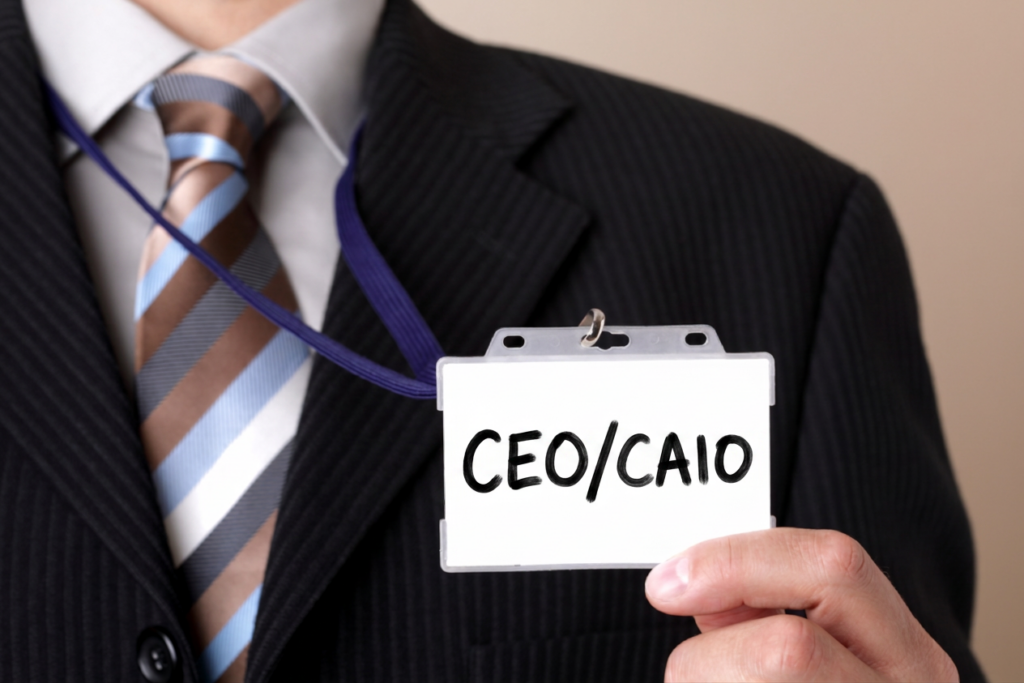

Many companies claim to have an AI strategy, but how many have a CEO who treats it as a personal, hands-on responsibility? Without that ownership and oversight, AI initiatives stall: tools get deployed, a chatbot goes live, a few workflows get faster, and…?
The promised “transformation” never reaches the rest of the business.
The title Chief AI Officer is ubiquitous, but a title doesn’t do the work. What moves an organization through genuine AI transformation is a practice, not a title. It comes down to three things:
A CAIO can manage the technology, but only a CEO can lead the change.
It is tempting to hand AI to the CTO, a newly minted CAIO, a product lead, whoever is closest to the infrastructure. It’s just technology, right? That person can absolutely recommend and deploy tools and track adoption. What they normally can’t do is carry and drive the mandate for organization-wide change.
AI isn’t a technology problem. It’s also a people problem, a process problem, and a strategy problem that happens to involve technology.
Here is where that becomes most evident:
| A CAIO handles the technology | Only a CEO can lead the transformation | |
|---|---|---|
| Change Management | Deploying new AI tools and tracking adoption. | Managing the emotional response: job security fears and workflow anxiety. It takes CEO-level conviction to get people beyond that. |
| Cross-Functional Impact | Coordinating dev, product, design, QA, and operations. Managing developer environments and data pipelines. | No department head holds the mandate to coordinate disruption happening across every function at once. |
| Strategic Alignment | Testing the latest large language models and infrastructure. | Keeping AI from splintering into siloed rogue experiments and making sure the outcomes support strategy, revenue, and EBITDA. |
“A department head can deploy a tool. Only a CEO has the conviction to move a workforce through the fear that comes with it.”
The strongest argument for CEO-led AI transformation isn’t a case study of what worked, but one that’s still being written.
I’m currently serving alongside the CEO of a healthcare IT company as Fractional COO and CTO, leading its AI transformation from the top. The company builds EMR-integrated software for hospitals, and a heavily regulated environment makes every decision fraught.
Compliance is non-negotiable. Healthcare IT operates under HIPAA and strict regulatory oversight, so the company doesn’t have the luxury of experimenting carelessly with AI. Governance and guardrails are absolutes, not options.
Workflow complexity is high. Patient intake, consents, downtime events, and forms management are all intricate and interdependent. That is the complexity AI has to work within, not add to.
The CEO transformation is live. To date, the lessons are still being learned, the wins and losses are recent, and the results are still being built. That’s probably the honest state of most real AI transformations right now, not the polished case study version.
Four stages, one destination: CEO-led, organization-wide AI aimed at outcomes.
As mentioned, most companies have some AI activity happening somewhere in the business. Many of those projects are working through (or stuck in) some point in the sequence below. Remember, each stage builds on the last; there is no skipping ahead. At least, not successfully.
In my experience, most companies are stuck between Team Tools and Traction, calling it an AI strategy. It isn’t, it’s a starting point.
AI-as-marketing language. No real deployment.
Note-takers, writing, spelling, plans, research.
Chatbots, vibe coding, early process improvements.
CEO led, organization-wide AI. Aimed at outcomes.
When managed correctly, a dedicated AI engine drastically increases development capacity.
Picture the development team hooked to a jet engine. You can’t make engineering faster and leave product, design, QA, and the business at the old speed. The whole system has to recalibrate. Once AI accelerates development, the pressure trickles (or pours) down to every function downstream of engineering, till they all feel the pace change at the same time.
This isn’t a question of replacing developers, but multiplying their output. The organization around them has to be restructured to absorb that pace.
Product. Prioritization breaks down when development ships faster than specs arrive.
Design. Iteration outpaces validation. Sign-off has to happen when the cycle compresses to days.
QA. Manual testing cannot keep up. The entire function needs rethinking: tools, skills, headcount.
Business. Requirements intake was not built for this pace. Every handoff becomes a chokepoint.
Build and deploy the AI engine step by step. Go slow, refine, and let the gains compound.
Step 1, Crawl (current state). Have your business structure in place first, EOS or an equivalent. Target AI at specific, defined roadmap features. Go slow and refine, test and correct. Expect both wins and failures. Assess at 1x capacity, aiming for the 10x target.
Step 2, Walk (moving forward). Agentic projects go live quicker. The team is trained, and milestones are explicit. Operational speed increases and compound gains start to accelerate.
Step 3, Run (the destination). 8-10x capacity gains are fully realized. AI infrastructure is built and embedded across every development function. The C-suite actively re-evaluates strategy, spend, and timelines.
Be honest with yourself about where you are. Don’t call yourself a “walk” company if you’re still “crawling.” Without a business structure in place, AI splinters across teams with no coherent outcome.
A look at the mechanics behind the numbers:
The end-to-end prerequisite. End-to-end repo automation is required just to get through the initial stages. Every main function has to be rebuilt to flow into and out of the AI engine.
All roles and functions change. Product requirements are the fuel. Moving to 10x places enormous pressure on the roadmap, and traditional bottlenecks get eliminated across coding, QA, and project management.
The CEO checkpoint. CEO involvement is what makes it possible to understand organizational impacts and encourage change. Without it, momentum stalls.
A CAIO with a sandbox. The company’s CAIO is paired with a dedicated R&D engineer who innovates in a sandbox, and the wins get operationalized back into the core development cycle. Understand that handoff isn’t always clean, it’s genuinely hard.
We’re still in early days yet. The gap between where we are and 10X isn’t a technology problem, but a change management and leadership problem.
These are the hard lessons that came directly out of doing the work.
Failure is not a setback. Projects will inevitably fail. Declare failure too early, and you kill the learning. A failed project often returns in a different form and can ultimately succeed. One project here fell short of its initial targets and resurfaced as a success in a different form.
Physical executive presence. The CEO needs to be in the room, not just informed on a dashboard. Being present early in an agentic project is leadership at every handoff.
Exposing broken processes. AI moves fast enough to make operational gaps visible in days, not weeks. Map your processes before you start, because AI will expose the good ones and the bad ones equally.
Guard the human voice. Watch for teams outsourcing their judgment entirely to AI. We’ve all seen the emails that reek of unbridled AI.
None of this is smooth. Anyone who tells you their AI transformation went smoothly is either very early or not very honest.
Five moves to make before the transformation, not after.
Treat AI as a core CEO responsibility, not an outsourced technology experiment. Sponsorship has to be visible, active, and consistent, not a one-time all-hands message.
Tie every AI initiative to a business objective. “We’re adopting AI” is not a goal, so tolerate zero “AI for AI’s sake.”
AI amplifies the current state of your operations. Map workflows before deploying, since AI will expose good and bad processes equally. Garbage in, garbage out: AI will execute your broken process faster.
The team structure you have today may not be the team you need tomorrow. Training works best when your own people are paired with outside AI specialists. You can’t just buy the tools and expect them to figure it out.
Align the strategy, build structural integrity first, test extensively, and only then accelerate to run.

“As the CEO transforms, the organization transforms.”
– Peter Clifton, Fractional CEO, COO & CTO Partner, TechCXO
Get the latest insights from TechCXO’s fractional executives—strategies, trends, and advice to drive smarter growth.
Many companies claim to have an AI strategy, but how many have a CEO who treats it as a personal, hands-on responsibility? Without that ownership and oversight, AI initiatives stall: tools get deployed, a chatbot goes live, a few workflows get faster, and…?
The promised “transformation” never reaches the rest of the business.
The title Chief AI Officer is ubiquitous, but a title doesn’t do the work. What moves an organization through genuine AI transformation is a practice, not a title. It comes down to three things:
A CAIO can manage the technology, but only a CEO can lead the change.
It is tempting to hand AI to the CTO, a newly minted CAIO, a product lead, whoever is closest to the infrastructure. It’s just technology, right? That person can absolutely recommend and deploy tools and track adoption. What they normally can’t do is carry and drive the mandate for organization-wide change.
AI isn’t a technology problem. It’s also a people problem, a process problem, and a strategy problem that happens to involve technology.
Here is where that becomes most evident:
| A CAIO handles the technology | Only a CEO can lead the transformation | |
|---|---|---|
| Change Management | Deploying new AI tools and tracking adoption. | Managing the emotional response: job security fears and workflow anxiety. It takes CEO-level conviction to get people beyond that. |
| Cross-Functional Impact | Coordinating dev, product, design, QA, and operations. Managing developer environments and data pipelines. | No department head holds the mandate to coordinate disruption happening across every function at once. |
| Strategic Alignment | Testing the latest large language models and infrastructure. | Keeping AI from splintering into siloed rogue experiments and making sure the outcomes support strategy, revenue, and EBITDA. |
“A department head can deploy a tool. Only a CEO has the conviction to move a workforce through the fear that comes with it.”
The strongest argument for CEO-led AI transformation isn’t a case study of what worked, but one that’s still being written.
I’m currently serving alongside the CEO of a healthcare IT company as Fractional COO and CTO, leading its AI transformation from the top. The company builds EMR-integrated software for hospitals, and a heavily regulated environment makes every decision fraught.
Compliance is non-negotiable. Healthcare IT operates under HIPAA and strict regulatory oversight, so the company doesn’t have the luxury of experimenting carelessly with AI. Governance and guardrails are absolutes, not options.
Workflow complexity is high. Patient intake, consents, downtime events, and forms management are all intricate and interdependent. That is the complexity AI has to work within, not add to.
The CEO transformation is live. To date, the lessons are still being learned, the wins and losses are recent, and the results are still being built. That’s probably the honest state of most real AI transformations right now, not the polished case study version.
Four stages, one destination: CEO-led, organization-wide AI aimed at outcomes.
As mentioned, most companies have some AI activity happening somewhere in the business. Many of those projects are working through (or stuck in) some point in the sequence below. Remember, each stage builds on the last; there is no skipping ahead. At least, not successfully.
In my experience, most companies are stuck between Team Tools and Traction, calling it an AI strategy. It isn’t, it’s a starting point.
AI-as-marketing language. No real deployment.
Note-takers, writing, spelling, plans, research.
Chatbots, vibe coding, early process improvements.
CEO led, organization-wide AI. Aimed at outcomes.
When managed correctly, a dedicated AI engine drastically increases development capacity.
Picture the development team hooked to a jet engine. You can’t make engineering faster and leave product, design, QA, and the business at the old speed. The whole system has to recalibrate. Once AI accelerates development, the pressure trickles (or pours) down to every function downstream of engineering, till they all feel the pace change at the same time.
This isn’t a question of replacing developers, but multiplying their output. The organization around them has to be restructured to absorb that pace.
Product. Prioritization breaks down when development ships faster than specs arrive.
Design. Iteration outpaces validation. Sign-off has to happen when the cycle compresses to days.
QA. Manual testing cannot keep up. The entire function needs rethinking: tools, skills, headcount.
Business. Requirements intake was not built for this pace. Every handoff becomes a chokepoint.
Build and deploy the AI engine step by step. Go slow, refine, and let the gains compound.
Step 1, Crawl (current state). Have your business structure in place first, EOS or an equivalent. Target AI at specific, defined roadmap features. Go slow and refine, test and correct. Expect both wins and failures. Assess at 1x capacity, aiming for the 10x target.
Step 2, Walk (moving forward). Agentic projects go live quicker. The team is trained, and milestones are explicit. Operational speed increases and compound gains start to accelerate.
Step 3, Run (the destination). 8-10x capacity gains are fully realized. AI infrastructure is built and embedded across every development function. The C-suite actively re-evaluates strategy, spend, and timelines.
Be honest with yourself about where you are. Don’t call yourself a “walk” company if you’re still “crawling.” Without a business structure in place, AI splinters across teams with no coherent outcome.
A look at the mechanics behind the numbers:
The end-to-end prerequisite. End-to-end repo automation is required just to get through the initial stages. Every main function has to be rebuilt to flow into and out of the AI engine.
All roles and functions change. Product requirements are the fuel. Moving to 10x places enormous pressure on the roadmap, and traditional bottlenecks get eliminated across coding, QA, and project management.
The CEO checkpoint. CEO involvement is what makes it possible to understand organizational impacts and encourage change. Without it, momentum stalls.
A CAIO with a sandbox. The company’s CAIO is paired with a dedicated R&D engineer who innovates in a sandbox, and the wins get operationalized back into the core development cycle. Understand that handoff isn’t always clean, it’s genuinely hard.
We’re still in early days yet. The gap between where we are and 10X isn’t a technology problem, but a change management and leadership problem.
These are the hard lessons that came directly out of doing the work.
Failure is not a setback. Projects will inevitably fail. Declare failure too early, and you kill the learning. A failed project often returns in a different form and can ultimately succeed. One project here fell short of its initial targets and resurfaced as a success in a different form.
Physical executive presence. The CEO needs to be in the room, not just informed on a dashboard. Being present early in an agentic project is leadership at every handoff.
Exposing broken processes. AI moves fast enough to make operational gaps visible in days, not weeks. Map your processes before you start, because AI will expose the good ones and the bad ones equally.
Guard the human voice. Watch for teams outsourcing their judgment entirely to AI. We’ve all seen the emails that reek of unbridled AI.
None of this is smooth. Anyone who tells you their AI transformation went smoothly is either very early or not very honest.
Five moves to make before the transformation, not after.
Treat AI as a core CEO responsibility, not an outsourced technology experiment. Sponsorship has to be visible, active, and consistent, not a one-time all-hands message.
Tie every AI initiative to a business objective. “We’re adopting AI” is not a goal, so tolerate zero “AI for AI’s sake.”
AI amplifies the current state of your operations. Map workflows before deploying, since AI will expose good and bad processes equally. Garbage in, garbage out: AI will execute your broken process faster.
The team structure you have today may not be the team you need tomorrow. Training works best when your own people are paired with outside AI specialists. You can’t just buy the tools and expect them to figure it out.
Align the strategy, build structural integrity first, test extensively, and only then accelerate to run.
“As the CEO transforms, the organization transforms.”
– Peter Clifton, Fractional CEO, COO & CTO Partner, TechCXO

Get the latest insights from TechCXO’s fractional executives—strategies, trends, and advice to drive smarter growth.