Brantley Fry
Human Capital; Fractional CHRO, COS, CAO


TechCXO Podcast | Episode 1
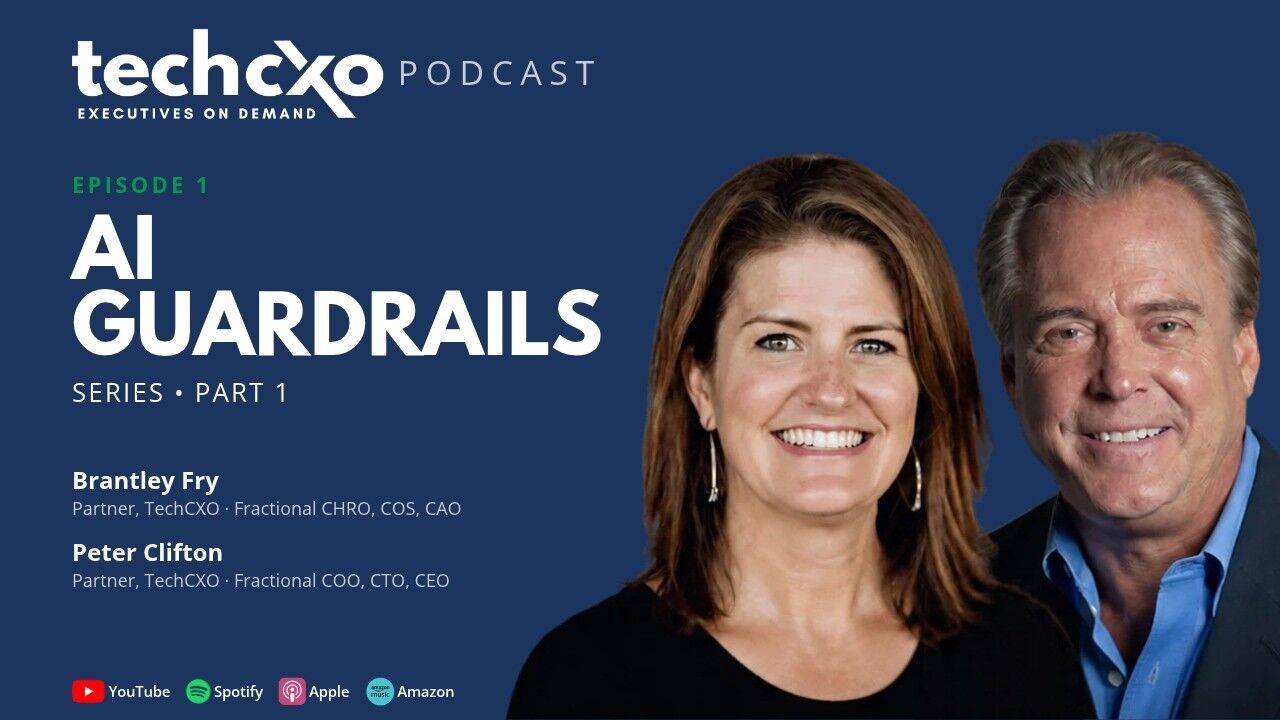
In the first episode of the TechCXO Podcast, Peter Clifton and Brantley Fry discuss AI guardrails, governance, and why keeping the right humans in the loop matters. Drawing on their experience as fractional executives, they explore how growing companies can put AI to work without losing sight of business objectives, accountability, or the people responsible for making it all work.
Share:
Listen:

About this Episode
AI is changing how companies work, but it doesn’t change who’s responsible for the results. Leadership still determines when a real person needs to step in, ask questions, and make the right call.
In the first episode of the TechCXO Podcast, Peter Clifton and Brantley Fry discuss AI guardrails, governance, and why keeping the right humans in the loop matters. Drawing on their experience as fractional executives, they explore how growing companies can put AI to work without losing sight of business objectives, accountability, or the people responsible for making it all work.
An AI policy is only useful if it addresses the right business problem. And a human reviewer is only effective if they have the expertise and authority to challenge the output. As companies move beyond experimenting with AI and begin incorporating it into daily operations, those distinctions are critical.
Peter brings experience across CEO, COO, and CTO roles. Brantley brings expertise in human capital, people operations, and organizational change. Together, they look at what happens when AI moves from an interesting technology experiment to something a business actually depends on.
The conversation covers managing AI agents, the importance of experienced employees in providing effective oversight, and why building an AI solution is often easier than making it work inside a business. They also discuss a cautionary tale: how a law firm’s use of AI-generated legal citations went unchecked and what happens when human oversight falls short.
The takeaway? AI can change how work gets done. It doesn’t eliminate the need for experienced leadership, sound judgment, or accountability.
Just putting a human in the loop who can’t do anything, that has no authority and has no expertise, is pretty useless. You’re effectively abdicating at that point that the technology can do whatever it pleases.
What You'll Learn
Define the problem before selecting an AI tool or writing a policy.
Reviewers need relevant expertise, clear expectations, and the ability to challenge results.
Experienced employees help shape better inputs, evaluate outputs, and identify mistakes.
Clear communication and thoughtful timing help employees understand changing roles and maintain trust.
Delegating work still requires someone to define success, evaluate performance, and own the outcome.
Read Along
They were putting their name on it. the partner, without even checking the work. And it turns out that they weren't
Oh my God.
It's one thing to put a person in the loop, but if the person doesn't have the expertise and they don't have the knowledge, then they're just there. You know, either as a I don't know what they're there for, but they're not going to be very productive.
Hey, Peter. How are you?
I am a partner with the Human Capital Management Practice at TechCXO, and I've been with a firm for about a year and a half now, and I support our clients as they go through inflection points and need strategic advice on people operations. So that varies from organizational design to leadership training to how to implement AI from a people, guardrails and governance perspective.
So lots, lots moving in the AI space, as you know, but it's really fun to think about it from a people perspective.
Definitely. So when you hear the term AI guardrails and governance, and how do you think about that? Like how would you define that?
Yeah, it's a great it's a great element of AI. And that's become kind of a catchphrase. Right. What do we think about human in the loop? And the short answer from my perspective is that the human is always going to be in the loop. It's to some degree it's just to what degree. And I love working with clients to help define that.
And
it's funny because when when you were talking about guardrails and governance, that is the first step that people think about often is, okay, we need a policy. And I have plenty of clients that ask me to help them develop a policy, but I always ask the follow up question before we go into the policy development is what is what is it that you're trying to achieve with this policy?
Is it is it just based on security? Is it based on decision rights? Is it based on accountability? There's so many elements to think about in terms of how your people interact with that policy and what the goal is overall. Because if we're just making policy for policy sake or to check a box and say we have an AI policy, that's not going to work, it makes it hard to enforce.
It makes employees resent it. I mean, I think about examples where people, at least initially this is I'm seeing this tamp down a little bit as we get more familiar with AI and people are less afraid of it. But initially the gut reaction was lock everything down, don't let anybody use AI at all. And there's still some companies that that take that stance, but they're becoming fewer and far between.
But so what what do you think about the policy? How do you see the policy element in your in your practice from an exec ops perspective?
Yeah, right.
Sure.
Yeah. I mean, I think about this, this AI transformation and this. You're right. This is such a huge transformation in such a short amount of time. I mean, the uptake on AI, I don't know all the statistics off the top of my head, but you look at these graphs and they're just insane compared to other technologies that have been adopted over time.
But when I think about it, in this transformation, I think about how do we implement change management practices through this transformation? So it's not necessarily that we have to reinvent the wheel as it relates to AI. It's backing up and thinking about what is what works in the past. Anytime you're making a transformation in your company, big or small.
So what are some of those change management principles. And always shorten it a little bit into the most basic thing that people ask in in change. And how is it going to affect me. Right. So if you, as a leader in your company, can start thinking about how do we answer that question for our employees so that they have a sense of security and clear expectations around this change, and that we're able to get buy in from them in a way that they're excited about these changes and not threatened by them.
Those are kind of the basic elements that I often talk to clients about. I had one client recently and they were questioning, one of the functions within the organization. They were questioning whether it made sense to just outsource this, for lack of a better word, to AI. And I was able to talk to them and kind of talk them off the ledge, so to speak, because it it occurred to me that the, the role and the person that they had in that role has a vast amount of knowledge and as a senior person in the field, and instead of getting rid of all of that knowledge and just relying on AI to do
it, that person is exactly the type of person you want to be in the loop, because they're going to help you with inputs. I mean, we think about output and making sure that whatever the AI spits out is accurate and not hallucinating and all of these things. But we also, I think, sometimes forget about the input. Who is the person who is prompting the AI, and how is that?
How is their expertise being leveraged so that the output is done, to the level of excellence that the that the organization wants and needs for their clients. So I love thinking about it from a change management perspective, but also thinking about how do we leverage resources that are already at our fingertips to enhance them, not necessarily get rid of them?
Yeah, yeah, I love that. And I love that what you said about the processes, it reminds me I have a client. They actually just exited. They have a great story. But they are one of the most healthy leadership teams that I've had the pleasure working with. And one of the things that made them so healthy is they challenged each other's ideas in a way that was very productive, to sharpen those ideas and make the best of the company.
But they also took time to back up and ask kind of root cause questions. So if they were changing a process and let's say they were changing a process or implementing a process in order to have AI support or even take over that process, what they did was they backed up and they asked why? What is it? What does success look like?
What are we trying to accomplish with this process? And then they put AI over it as opposed to the other way around, so that they were again able to think about the input so that the output really met their needs. And it was fascinating. They were they're a SaaS company. And, they were accustomed to working in the AI space long before it became into this.
The consumer space, as you mentioned earlier. So they already had a sense of what the capabilities were, but then they were able to think through, okay, now that we have expanded capabilities from a consumer and a perspective, how do we overlay those capabilities against the process we processes we already know work well for our company and for our clients.
So I love thinking about it from a root cause perspective as well.
Yeah.
That's right, that's right.
Yeah. And that's the whole human in the loop
component. So when you think about the the change management elements and bringing a large AI, transformation into an organization, what are some of the the pieces that you think of first, as far as the human components, like, what are the questions that you start to ask around who does, who does what and when and who's held accountable?
I mean, what are how do you think through that process?
Definitely.
Yeah, I agree, and it has one really cool thing about AI is that it's opened people's eyes to different possibilities that they might not have thought of otherwise. Of course, there's some dangers to that too. You have to verify that those possibilities are, in fact, real. But but it is exciting for from that perspective. So
I'm thinking about we've talked about some of the big picture pieces, and I'm thinking about some of the more tactical pieces
that I run into
as it relates to people, operations and organizational design.
And one of the things that I talk to clients about, and in fact, I was having a conversation with the CEO this morning, and he was talking about an agent that he had created. And, he had been able to do so in a way that it was a task that he typically delegated,
and which was great, but it raised the idea, and this is not a new idea, but really emphasized the idea that we are delegating tasks to AI.
And if we're delegating those tasks, how are we managing them? Because if we're thinking about an agent, as an employee, or as a member of your team, how are we managing that? How are you? How does that play out in your clients? Have you are you seeing that?
Sure.
Oh.
Right. Yeah. No, I agree and I love the accountability question to you. I mean that's something obviously that comes up in people operations all the time is how do you articulate clear expectations and then hold your team to those expectations and, and keep people accountable. And if we're not asking those same questions of our AI tools, it's a it's a real risk in terms of how we're delivering for clients, how our our clients are delivering for their clients.
Yeah. Well, I always start with asking the question that I referred to earlier, which is what is your ultimate goal in this? What are what is it that you're trying? What is the business problem that you're trying to solve? Is it cutting cost? Is it increasing efficiency? Is it all of the above? Is it someone who's not performing well?
I mean, there are myriad reasons why a leader might want to make some of these changes. And so understanding their motivation behind that is critical. And I don't think you can understand the motivation of a machine necessarily. So again, thinking about this change management element from a, from a motivational standpoint to understand what a success look like and what is it that you're trying to achieve.
And so I start there and then based on their answers, we think through solutions that work best for their bottom line, that work best for their culture. I've got, a client. This is not a current client. I had a client last year that had undergone some restructuring, and, they had another change that they wanted to make that required some additional moves or that might have required some additional moves with, with personnel.
And they were using AI to supplement some of those needs. And we pause that because what we realized is we were sending a message to the team that they there was so much change happening and people were like, well, when am I next? Like, what's happening to my job next? And so in, in making some of these moves that we ultimately hoped to enhance the culture, the, the leadership had gotten a little bit ahead of their skis and not asked the question, okay, so we will make these changes eventually, but let's do it in a way that supports our culture and that makes people feel like they are in a secure environment where they can
do their very best work. So, timing is also a huge question. Timing and scope, or also questions that I, that I want to understand so that the leadership team is looking at not just the single implementation implementation or excuse me, implication, but the whole for the organization and what's best for the organization. What about you?
How would you answer that question?
Go.
Right. That's right.
Yeah, I love that. I love what you said about the ultimate accountability and having the expert who's, you know, who's ultimately responsible for the output. There's this is a pretty extreme example, but there's a local example here in Birmingham, based in Birmingham, Alabama. There is a law firm that was sanctioned by the court. I'm a lawyer by training, so I pay attention to this.
This was not a this was not a client. But it relates to accountability in AI. And this law firm had been sanctioned by the court because they submitted a brief that included hallucinated cases and inaccurate cites and all of these things in the brief. And what was really interesting about that is, as is typical in a law firm, the, the the associates write the brief and then the partners are ultimately responsible for, for submitting them to the court and putting their name on it.
And it's it's not dissimilar. They were putting their name on it, the partner, without even checking the work. And it turns out that they weren't checking just their their associates work. They weren't checking the AI's work. Right. So it became kind of two levels that needed to be checked. The associate didn't check the AI output, and then the partner didn't check the associate's work.
And so that has real world consequences. And that's one like I said, that's an extreme example. But, that that law firm had sanctions as a result.
I don't believe so.
Oh. Oh it most definitely has. I mean, I've read about it in other places. This just happened to be a local example, so I was paying attention more.
It is. And we actually have a really interesting organization here in town called Birmingham AI. They're a nonprofit, and their goal is to educate business people around the city on how to use AI. And I mean, I forget their exact tagline, but it's something to the effect of making sure that AI is happening for us and not to us. And so they have a number of education.
They have a number of education programs, and this organization has just bloomed. They now have a partnership with Claude. So Anthropic is here in town doing workshops. So it's a really cool organization, and it's a really proactive organization in making sure that that the business community here, as well as the workforce in general, is educated on the the benefits and drawbacks of AI.
So, yes, to answer your question, we are seeing a huge amount of uptake here. As as is true in most places, but I think that organization is fairly unique and they've had great success, and I think they've even gotten national press on in some of their work.
Right? Yeah, they're really, really interesting people. They're doing good work.
Right. Well, and think about the conversations we were having six months ago. I mean, six months and a year ago, we were having conversations a little bit. How we started this, which was related to to policies around it was only guardrails. It wasn't possibilities. And now I think the posture has changed dramatically, where leadership is saying, how do we use this better?
And and it's also more, more strategic. So I love the way these conversations are evolving, because I think the other knee jerk reaction, aside from not using it was the reverse, which was let's use it for everything. And and so I think we started that some of that is starting to settle out. And leaders are really thinking more strategically around this is what we're trying to accomplish.
This is a tool that we can use. And what you said earlier about the strategic plan was so important. The strategic plan is the strategic plan. AI is not the plan, it's the tool you use to get you there. So I love seeing the evolution of that even in the last 6 to 12 months. It's amazing.
a every
Right?
That's right.
That has that is a newer problem for sure. It really is exciting.
Yeah. I've enjoyed this conversation. Thank you. I'm looking forward to having it in the next few months, so that we can talk about what's changed in that amount of time.
I hope you do. I hope you do. And I was about to say, and vice versa. And likewise. It's been such a pleasure. So thank you.
Thank you.
In this Episode

Subscribe to the TechCXO Podcast
Conversations with TechCXO partners on the leadership questions growing companies face right now.
Keep Exploring
If you’ve never outsourced or used executives on demand before, you’re sure to have a lot of questions. Don’t worry, we’re more than happy to answer them all.
And we know everything there is to know about this unique model. Schedule a call with us or send an email now.
