Peter Biro
Partner


How growing businesses can turn location data into earlier action.
A P&L is a history report. It tells leaders what happened after the month is already over.
For a business with multiple locations, that delay can be expensive. A weaker conversion rate, slower retention, lower utilization, or a pricing issue may be building inside one location long before it shows up clearly in the financials.
As a TechCXO fractional CFO, I see this as one of the most practical opportunities for AI in multi-location management. Used well, AI can turn scattered data into information leaders can use while there is still time to coach a manager, review a process, or test a different approach.
Multi-location businesses do not scale like software companies. Growth depends on the economics inside each unit, from staffing and traffic to customer experience, utilization, pricing, and local execution. A 10-location company may look like one business from the outside. Inside the business, each location has its own patterns and pressure points. AI becomes useful when it helps leaders see which differences deserve attention.
A location’s monthly numbers can tell leaders that something changed, but they rarely explain where the change began or which decision deserves attention first. By the time weaker conversion or retention appears in a P&L, the underlying issue may have been developing for weeks or months. The P&L is a lagging indicator.
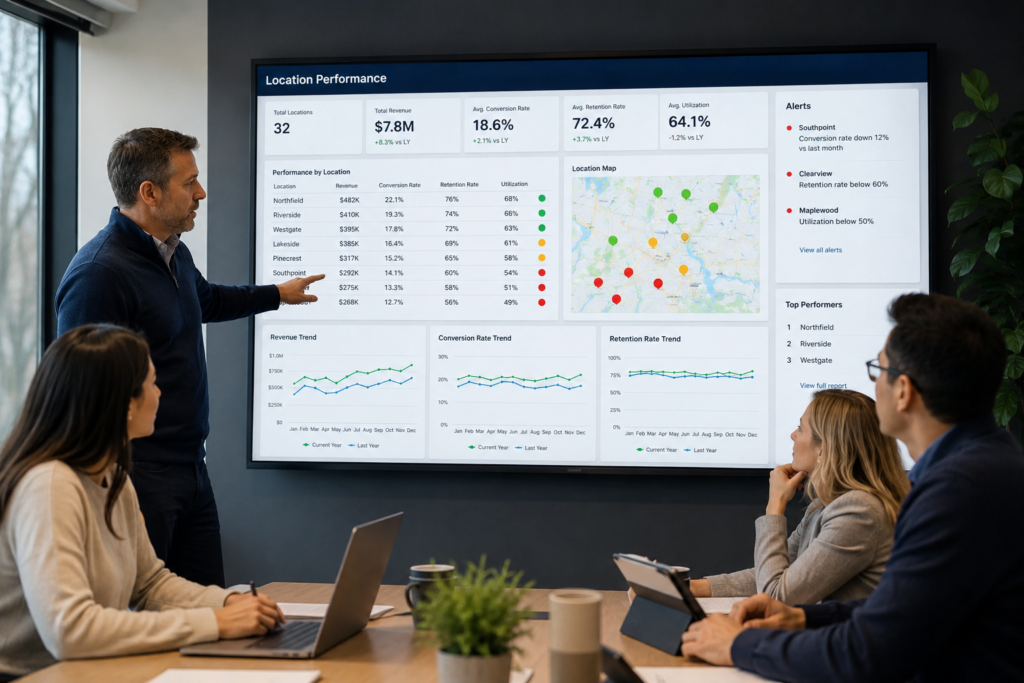
In my client work, I use AI to make location-performance analysis easier. In a membership business, leaders need to understand how effectively each location manager converts tours into members and how well those members are retained. I can export the relevant raw data into a spreadsheet and ask Claude to analyze it, but the bigger breakthrough comes from connecting the systems behind the analysis.
I also build workflows that sync data, run analysis, and share results with sales, operations, and finance leaders within the tools they already use. The real value is a more connected way to turn raw data into information the business can act on. For example, turning leading indicators on bookings into a simple weekly Slack update helps to increase visibility and drive urgency.
A weaker conversion rate may point to a problem with the tour experience. Retention may warrant a closer look at service, pricing, or the local market. When sales, operations, and finance start from the same information, the business has a stronger place to begin. The system does not make the operating decision for them. It helps them get to the right conversation faster.
Before AI tools like this, a business might have hired an analyst, paid for expensive enterprise software, or simply gone without the analysis. Now, a smaller multi-location business can reach that level of visibility much faster, especially when systems are connected and the analysis reaches the leaders who need it.
For a smaller multi-unit business, this can be a practical first use case. Begin with three basics:
For membership businesses, conversion and retention are central. Other businesses may focus on other metrics like utilization, occupancy, realized price, or revenue by location. AI for brick-and-mortar businesses can turn existing location data into a clearer basis for those decisions.
The best starting point is usually a question the business already needs to answer. One location may be converting fewer tours. Another may be struggling with retention. A third may have strong traffic but weak utilization.
AI can help leaders answer those questions faster. The workflow still needs business judgment. Leaders need to know which measures matter, where the data comes from, who receives the analysis, and what action should follow.
For multi-location management, the value comes from earlier action. A useful AI workflow helps the business see what is changing and respond before a small operating issue becomes a larger financial problem.
Looking for the right place to start with AI? TechCXO’s AI services help companies define the business problem, prepare the data, and build practical workflows that improve how decisions get made.
Get the latest insights from TechCXO’s fractional executives—strategies, trends, and advice to drive smarter growth.
A P&L is a history report. It tells leaders what happened after the month is already over.
For a business with multiple locations, that delay can be expensive. A weaker conversion rate, slower retention, lower utilization, or a pricing issue may be building inside one location long before it shows up clearly in the financials.
As a TechCXO fractional CFO, I see this as one of the most practical opportunities for AI in multi-location management. Used well, AI can turn scattered data into information leaders can use while there is still time to coach a manager, review a process, or test a different approach.
Multi-location businesses do not scale like software companies. Growth depends on the economics inside each unit, from staffing and traffic to customer experience, utilization, pricing, and local execution. A 10-location company may look like one business from the outside. Inside the business, each location has its own patterns and pressure points. AI becomes useful when it helps leaders see which differences deserve attention.
A location’s monthly numbers can tell leaders that something changed, but they rarely explain where the change began or which decision deserves attention first. By the time weaker conversion or retention appears in a P&L, the underlying issue may have been developing for weeks or months. The P&L is a lagging indicator.
In my client work, I use AI to make location-performance analysis easier. In a membership business, leaders need to understand how effectively each location manager converts tours into members and how well those members are retained. I can export the relevant raw data into a spreadsheet and ask Claude to analyze it, but the bigger breakthrough comes from connecting the systems behind the analysis.
I also build workflows that sync data, run analysis, and share results with sales, operations, and finance leaders within the tools they already use. The real value is a more connected way to turn raw data into information the business can act on. For example, turning leading indicators on bookings into a simple weekly Slack update helps to increase visibility and drive urgency.
A weaker conversion rate may point to a problem with the tour experience. Retention may warrant a closer look at service, pricing, or the local market. When sales, operations, and finance start from the same information, the business has a stronger place to begin. The system does not make the operating decision for them. It helps them get to the right conversation faster.
Before AI tools like this, a business might have hired an analyst, paid for expensive enterprise software, or simply gone without the analysis. Now, a smaller multi-location business can reach that level of visibility much faster, especially when systems are connected and the analysis reaches the leaders who need it.
For a smaller multi-unit business, this can be a practical first use case. Begin with three basics:
For membership businesses, conversion and retention are central. Other businesses may focus on other metrics like utilization, occupancy, realized price, or revenue by location. AI for brick-and-mortar businesses can turn existing location data into a clearer basis for those decisions.
The best starting point is usually a question the business already needs to answer. One location may be converting fewer tours. Another may be struggling with retention. A third may have strong traffic but weak utilization.
AI can help leaders answer those questions faster. The workflow still needs business judgment. Leaders need to know which measures matter, where the data comes from, who receives the analysis, and what action should follow.
For multi-location management, the value comes from earlier action. A useful AI workflow helps the business see what is changing and respond before a small operating issue becomes a larger financial problem.
Looking for the right place to start with AI? TechCXO’s AI services help companies define the business problem, prepare the data, and build practical workflows that improve how decisions get made.


Get the latest insights from TechCXO’s fractional executives—strategies, trends, and advice to drive smarter growth.