
• Insights
  • Careers
  • Contact Us
TechCXO-Logo
TechCXO Home Page Logo
  • Fractional Leadership
        • Fractional Leadership

        • Chief Financial Officer (CFO)
        • Chief Executive Officer (CEO)
        • Chief Operating Officer (COO)
        • Chief Technology Officer (CTO)
        • Chief Product Officer (CPO)
        • Chief Information Officer (CIO)
        • Chief Marketing Officer (CMO)
        • Chief Information Security Officer (CISO)
        • Chief Sales Officer (CSO)
        • Chief Revenue Officer (CRO)
        • Chief Human Resource Officer (CHRO)
        • Chief Customer Officer (CCO)
        • Chief Artificial Intelligence Officer (CAIO)
        • Executive Team Coaching
  • Services
        • Services

        • Capabilities

        • Services

        • Executive Leadership
        • Finance & Accounting
        • Human Capital
        • Product & Technology
        • Revenue Growth
        • Capabilities

        • Private Equity & Venture Capital
        • AI
  • Industries
        • Industries

        • Business Services
        • Consumer & Retail
        • Energy & Power
        • Financial Services
        • Healthcare & Life Sciences
        • Industrials
        • Media & Communications
        • Real Estate
        • Technology & Software
  • Resources
        • Resources

        • Blogs
        • Guides
        • News
        • Case Studies
  • About Us
        • About Us

        • Contact Us
        • History
        • People
        • Locations
Schedule a 15-Min Call
Search field required with a minimum length of 3 characters

Incentive Stock Options Guide

Creating Incentive Stock Option Plans

The appeal of stock options for startups and earlier-stage companies may not be what they once were, but there remains a high expectation on the part of your best employees that they will one day share in the runaway success of the firm. Stock options, particularly those that are fully vested, are a significant motivator, ensuring that employees are aligned with the long-term goals of the company.

Your chances for attracting and retaining the top tier people you need for success are much better with some up front equity budgeting by founders and careful annual thinking about the equity pool you’ll need going forward for both new hires and merit-based awards to existing key contributors.

Incentive Stock Option (ISO) Plans remain an important retention and motivation strategy. There is room to get creative with ‘synthetic’ options and bonuses tied to successfully completed projects and key milestones. By offering these options, companies can manage the exercise price effectively, ensuring it aligns with the price and the fair market value of the company shares at the time of grant.

Equity Still Matters

As unicorns and IPOs have become more rare, the appeal of stock options for startups may not be what it once was, but ISOs remain table stakes for startups that want to draw exceptionally talented people. The favorable tax treatment of ISOs, especially when compared to the alternative minimum tax, makes them a more attractive option for employees.

There is more inherent power and flexibility in ISOs for recruiting and retention than many founders may realize. Also, a management team can get extraordinarily creative in using synthetic and restrictive options based on the successful completion of a particular project or initiative. This creativity can extend to managing the expiration date of options to maximize their benefit to both the company and the employee.

Founders’ Equity

Founders are generally good at thinking through equity allocations among themselves, but something easily overlooked in the early capitalization structure is model options for new employees. Understanding the impact of equity grants on future dilutive events is crucial, particularly in how they relate to qualified stock options and their tax implications, including long-term capital gains considerations.

The size of the initial option pool you need available depends on the executive team you have on hand and those you will need. For example, if among your founders you already have your CEO, COO, CTO, and other key executive team members, you may only need a pool of 10-12% of fully diluted shares available to create a suitable equity compensation plan. However, if you are yet to bring on several key members of your executive team, you may need 15-17% or more of fully diluted equity in the equity pool. I’ve seen founders caught off guard because they needed to come up with 5% equity for the CEO they really wanted.

The earlier an equity incentive plan reserve can be built into an equity strategy, the sooner it can be leveraged, usually in the form of winning a star employee through the draw of equity (in exchange for a lower salary).

Budgeting for Equity

Building the Organization You Want

In addition to the executive team, you will need to think through your organization as it is and how you ideally want it to be. A good practice is to map out an entire organization chart and then do a bottoms-up budget for granting equity throughout the entire organization. Budget out at least two years or to the next anticipated equity raise, ensuring the income tax rate implications are considered for each equity grant.

One example – and this is merely an illustration as equity grants have many moving parts and variables – is if you anticipate the need for a great software engineering team, you may allocate for your Engineering VP 1%; a senior engineer 0.5%, and a line employee 0.25% (of fully diluted shares outstanding). Go through the same exercise for sales, marketing, operations, and other functions. To avoid confusion at the time of future dilutive events, it is always prudent to detail option grants as a specific number of shares versus a percentage.

Again, not only do you want to create a pool of equity for new hires, but for merit awards; particularly if your horizons for major events (such as IPO or an M&A transaction) stretch beyond 3-5 years.

Common Forms of Equity Incentives

The most common forms of equity incentives for the employees of startups are stock option plans, stock grants, and stock purchase plans.

Stock options are the most common and preferred form of equity-based compensation. A stock option gives the employee the right to purchase stock of the employer or its parent corporation. Stock options typically are granted to employees subject to vesting requirements, which prohibit exercise of the unvested portion of the option prior to completion of specified employment or service requirements (or may permit immediate exercise but with the stock subject to a repurchase right on the employer’s part that lapses over the vesting period in a manner similar to restricted stock).

An employee will generally receive one of two types of stock options: Incentive Stock Options (ISOs) or Nonqualified Stock Options (NSOs).

ISOs

Employees are typically granted ISOs, which must be granted subject to a formal stock option plan and are subject to certain restrictions. ISOs have favorable tax treatment for the recipient in most cases, often leading to long-term capital gain taxation rather than ordinary income tax rates. To ensure ISO treatment of option grants by the IRS, the company should follow certain rules to properly grant stock options to its employees including but not limited to having a valuation of its common stock performed on at least an annual basis or more often if material changes to the business have occurred. Improper option issuances may lead to unintended tax liabilities for both the company and the employee.

NSOs

NSOs are often issued to non-employees such as consultants, who are not eligible to receive ISOs or participate in statutory employee stock purchase plans, and to key employees or directors to whom the company wishes to grant options.

Assuming that the NSO does not have a “readily ascertainable value” at the time of grant (and virtually no NSOs do), there are no tax consequences for the optionee at the time of grant.

Rules of the Road for ISOs

  1. Stock Option Plan must be in writing;
  2. Stock Option Plan must be approved by the shareholders of the company within twelve months of the plan’s adoption by the board of directors (the plan may also be approved up to twelve months prior to adoption by the board);
  3. Options must be granted within ten years of the formal approval of the option plan;
  4. Options must expire less than ten years from issuance (or five years from issuance for any holders of more than 10% of the company’s stock);
  5. Options must be granted only to employees of the company (not to directors or consultants);
  6. Options must be exercised within ninety days of termination of employee status or one year following the death or disability of the employee;
  7. The value of the stock to vest in any one year under the option (based on the value at the grant date) shall not exceed $100,000; and
  8. Options may not be transferable except in the event of death by will or laws of distribution of assets.

Incentive Projects

For companies with major milestones such as clinical trials and securing regulatory approval, incentives, and stock options can help motivate and direct work toward specific outcomes.

Whether you incentivize key contributors or energize projects, Incentive Stock Option Plans remain an important retention and motivation strategy. For detailed plan development, schedule a call with us.

CFO Survey – Would you add Bitcoin to your balance sheet?

Bitcoin as a store of value and payment mechanism has been growing in acceptance as evidenced by some publicly traded companies putting a portion of their cash reserves into the cryptocurrency.

Tesla invested more than $1.5 billion in Bitcoin to its corporate balance sheet, noting that the purchase was made with cash not needed for operations.  Time Magazine, owned by salesforce.com inc.,  said it would also add Bitcoin to its balance sheet.  MicroStrategy has aggressively urged companies to shift corporate cash into cryptocurrencies like Bitcoin, and also announced it would be paying Board Members in Bitcoin.

TechCXO wanted to know where its CFO partners stood on the issue, so we surveyed 25 CFOs.  Many TechCXO clients are privately-held technology startups, and we asked them:

Resistance to Risk, Preserving Limited Cash

By a wide margin, TechCXO CFOs said they would not put cryptocurrencies onto client companies balance sheets. There were 21 “No”; 3 “Yes” and 1 “Maybe”.

When looking at the comments, the resistance was not necessarily due to not seeing crypto or Bitcoin as a legitimate asset, but more in response to their clients’ current cash and risk profiles. Some of the  comments added are below.

Currently I would not. Bitcoins are accounted for as intangible assets in the U.S. You cannot recognize gains until you sell but do have to write-down impairment if the price drops. Most of my current companies have limited cash resources. As such, they are risk averse.

Cash requirements precluded consideration:

Crypto is volatile. Our clients’ main goal with their funds is principal protection. Not until they have significant excess cash would I consider this as an investment thesis.

And:

The volatility of cryptocurrency erodes the ability to preserve capital. Most of my companies do not have enough capital to put it at risk.

However, some with more significant cash reserves would consider higher risk investments, even amending policies to do so:

One of my current clients, publicly traded, has raised a significant amount of equity that we have difficulty investing for any type of return. We have discussed amending our Investment Policy to allow up to 10% of investable cash for higher risk/higher reward investments, like Bitcoin.

Still others are ready to go:

One client I have has indicated he wants 5% – 10% of fundraising proceeds to be deposited in Bitcoin.

Startup or Start Over?

Is your startup now a start over? There is nothing wrong in that, so long as you have given it your best shot and learned from it. Maybe things centered around an undefined strategy, an unclear mission, an unaligned team, a disconnection with customers, an ill-defined market or perhaps some other oversight or stroke of bad luck? In any event, an after action review and thoughtful questions from an executive coach may reveal where things went wrong. TechCXO executive coach Piers Mummery explains.

The following article originally appeared on Pierso.co.uk

If at first you don’t succeed, try, try and try again. That is the nature of entrepreneurialism. Sometimes successful entrepreneurs get lucky on the first attempt, but more often than not, a successful entrepreneur will have made many mistakes before reaching success. The trick is to learn from your mistakes. Do not be afraid of making mistakes, nor admitting them to those around you. It’s OK to fail… I promise; I know, and I have been there!

An investor in one of my businesses said once, that it is not a crime to lose money, but it is a crime to run out of money. Now I buy that sentiment to a point in the context of a one-dimensional business, but most businesses can adapt and change and flex according to their circumstances and there are times when you set out with the best of intentions, based on all of the foresight and research and knowledge you have but due to a fundamental issue (often unforeseen), you may be heading on a trajectory towards failure.

I have a personal example of this in a garden retail business that I created and eventually sold. 2 years before we sold the business, we embarked on a very expensive and what we thought at the time would be a killer e-commerce plan to extend our products to our existing customers online. We spent a small fortune on instore promotion and a fantastic e-commerce site, with all the bells and whistles, but when we launched, we found the level of sales after just 2 months, wouldn’t have even paid for a celebratory drink!!

The fundamental reason for our failure that we found out was our existing customers preferred to physically visit our stores for their shopping experience and that in trying to get them to go online as well, we risked cannibalising our existing customers experience in the store. We took a very brave decision to shut down the service after a few months, having spent over six figures on the experience and a great deal of time and internal resources. The result was that we needed to start again, which we did, but with an emphasis on driving local web visitors physically to our stores through local marketing….it worked, but it was an expensive, six figure mistake we made.

The important point here is that there are times, when you give your business the best shot possible, you throw everything that you have and know to try and be successful, but even having done your best, you may not succeed and the skill of great people is to recognise this and make conscious changes. It was Albert Einstein who said the definition of insanity is doing the same things over and over again expecting different results.

Be prepared that at some point your Start Up business may just become a Start Over business and there is nothing wrong in that, so long as you have given it your best shot and learned from it.

Think about what you have learned. Maybe things centered around an undefined strategy, an unclear mission, an unaligned team, a disconnection with customers or perhaps some other stroke of bad luck.

Active Listening Quiz: Are You Really Listening as a Leader?

The Leadership Skill You’re Probably Overlooking: Active Listening

How good a listener are you?

The importance of active listening for business applications like customer success and customer experience management is clear: successful companies and executives are attuned to the needs and desires of what customers want. But there are simpler, day-to-day things like team meetings and one-on-one conversations through which the quality of the interactions has an enormous overall effect on important things like employee trust, productivity, corporate culture, and effectiveness of leadership.

Leaders are often poor listeners

Leaders are often the worst among us as listeners as they are so focused on driving growth, meeting numbers and deadlines, and asserting out authority that we often forget that our most valuable resource is our employees. That’s not just a cliché; Our employees usually have the deepest knowledge of our products, services, and customers. They often know more about how our organizations work than we do. They are the ones who can provide the context we need to actually meet our goals. But we can’t learn from them without listening.

Create your own user feedback survey

Social Enterprises

Paul Sansone, TechCXO partner and former CFO of the Boys and Girls Clubs of America and Better World Books, is an expert in social enterprises, social entrepreneurship and B Corps. Paul also serves as a member of the CASE (Center for Advanced Social Entrepreneurship) Advisory Council at Duke University.

Social entrepreneurship is the process of recognizing and resourcefully pursuing opportunities to create social value. With decades of experience in financials for social ventures, Paul knows what it takes for social ventures to raise capital. Learn what impact investors are looking for in their investments, raising capital as a B Corp, and trends he sees in social entrepreneurship. View Paul Sansone’s full bio.

Update: Issues for Non Profits in 2021

Recently, Paul also conducted a radio interview that included a discussion of issues Non Profits are facing in 2021. Starting at the 5:50 mark and through 9:00, he details some of the resource development and fundraising issues Non Profits faced in 2020 and the innovative strategy pivots they need to pursue in 2021 to carry out their mission. This may including some M&A activity among Non Profits. He goes on to talk about the entrepreneurship tactics of organizations like Goodwill and Habitat for Humanity.

Managing the Whole Person

How an Increase in Empathetic Leadership May Have Staying Power

What workplace changes will stick once the pandemic subsides? Maria Goldsholl, TechCXO’s Managing Partner – Human Capital, identifies three HR and leadership trends that will have staying power.

This article originally appeared on CirrusMD and their series on top trends in human resources

In a year when Zoom fatigue became a real thing, and millions of bosses and employees personally experienced any number of emotional and psychological challenges due to quarantines, stress and isolation, trends have emerged that may redefine workplace interactions for the better.

No one went untouched in 2020, and when all experience some pain and loss – including the boss — empathy can grow, particularly for leaders. Suddenly, stubborn, long-held biases held by some managers, such as “working remotely is just a way to sleep in and avoid work,” instantly vanish. When a manager is struggling with their own kids being out of school and stuck at home for months, they may be ready to extend more grace to single parents.

The pandemic has been a test of true leadership for many and a new perspective on viewing the whole person. Leaders have asked themselves, “How can we support people through this pandemic?” and “What really matters (and what is just corporate nonsense and busy work)”?

What emerges will be stronger, more holistic leadership with an eye toward prioritizing employee wellness, not just to reduce health insurance premiums, but to care for the whole person.

Here are three positive trends that may take hold.

New Respect for Wellness

It’s not a mistake that in the realm of “Health & Wellness” programs, Wellness is listed second. It may be an even more distant consideration than that. This year changed just how real mental and psychological wellness are for people. Physical health has always had quantifiable costs and benefits attached to it, including productivity, healthcare costs and culture. Now employers can more clearly connect how health and wellness have evolved with how contributors like sleep, exercise, and burnout all play a role in our overall mental health. What was otherwise considered a stigma to discuss has now become a mainstream part of the employee conversation.

Look for employers to offer their employees more through their wellness plans to diagnose things like sleep issues, and to lean more heavily into practical applications such as wearables that can monitor mental health.

Project Management, Prioritization & Efficiency get a boost

Almost all research suggests that people worked more, not less, this past year with the surge in remote working. Early on in the pandemic, frequent one-on-one check-ins were popular. However, as people tired of these tactics (Zoom fatigue) as overkill, they lobbied directly to supervisors to cut out endless forms and tedious meetings. With other things tugging at them, such as caring for children or parents, there was little time to waste on bureaucracy. Drawn out presentations became crisper. Online meetings got shorter and priorities became more pointed. Project management applications got a boost and soul-crushing, email-centric management got jettisoned.

More goals and objectives were turned into sprints with tidy deliverables and success criteria.

Performance Management Overtakes Performance Reviews and Evaluations

We’ve long lobbied for more of a performance management culture versus the overuse of quarterly and annual performance reviews.

Performance management calls for ongoing communication, a focus on clear actions, behaviors and results, and linking work to larger strategic objectives. In the year of more empathetic leadership, many company leaders reported that they are easing up on the dreaded end-of-year performance review. For example, Google skipped mid-year appraisals while the number of promotions doubled.

Shorter, more frequent check-ins actually made supervisors better informed as to how people were progressing. Managers were grateful too as some said getting rid of mid-year reviews saved them 20 hours or more.

We can all hope that leaders retain some of these trends, and that they no longer draw a hard line between a person’s work life and their personal life but rather view them as a whole person.

The Power of Compound Decision Making – Part 2

CEOs of private, mostly venture-backed growth companies know all too well the burden of high expectations, both in the milestones and scale they are trying to achieve.  Quality decision making is at a premium. In, Part 2 of “The Power of Compound Decision-Making” (PDF) we examine how to push high-velocity decision making deeper into your organization.

You can download Part 1 here (PDF).

Thoughts and Takeaways from SaaStr 2018

Last week I attended the annual SaaStr conference, where thousands of people in the SaaS community – Founder CEOs, VC & PE investors, operators and service providers of all stripes – descend upon San Francisco’s Hilton Union Square to learn, hear from and network with some of the most exciting upstart software companies in the world. This year, juxtaposed against the conference was the backdrop of a major stock market correction, where the DJIA dropped over 2,000 points in a single week amid concerns over rising interest rates. Having professionally invested through the 1999-2001 tech wreck and now as a CFO operator to my SaaS clients, the question running through my mind was what were the implications for an industry that has seen non-stop growth over the past decade?

Original article appeared February 2018. See notes from 2019 SaaStr conference, too.

Of course, a well-built business will survive, and oftentimes thrive – no matter the macro volatility. After attending about 20 sessions over 3 days, and hearing from many inspirational and battle-hardened entrepreneurs, there were several common themes that emerged from the conference. Below are my 3 big
takeaways:

Viraj Parikh TechCXO

Viraj Parikh is TechCXO’s Managing Partner in Nashville

  1. Software penetration is still very low – it is still early innings: Don’t let stock market volatility distract from this fundamental revolution. Tomasz Tunguz, a well-followed VC blogger, believes SaaS M&A will be very strong in 2018, after a weak 2017. Big cap tech companies flush with cash need to continue fueling their growth engines, and they are competing with PE funds that raised over $343 billion in 2017. That money will be put to work to continuously penetrate every corner of the global economy with cloud-based software. The median multiple is 7x forward ARR…growth is alive and well.
  1. A SaaS company’s journey to relevance is an exercise in de-risking the company To acquire a VC investment or become an attractive acquisition target, your company must begin with relevance. There are 3 stages in every start-up’s journey to a relevant state: a) product-market fit, b) search for a repeatable, scalable and profitable growth model, and c) scaling the model.

A. How does a CEO know whether they have achieved a Product-Market fit? They must meet two criteria:

    1. The company has a number of referenceable customer who have purchased the product
    2. Customers are happy, as evidenced by:
      • Product usage
      • A reluctance to give it up
      • Expanded usage
      • Low churn

B. After product-market fit is established, the startup must quickly transition to the search for a repeatable, scalable and profitable growth model:

    • Don’t try to boil the ocean – pick one target market with a single use case and benefit
    • Quickly close your early access sales
    • Invest in customer success to ensure your customers are accomplishing their goals
    • Build a buyer personae – what do they buy and what do they care about? – find a predictable and repeatable motion, and then begin scaling that process. For example, predictable sales bookings can be simplified to the number of sales reps times sales productivity
    • Understand your unit economics, and make it profitable.

C. Scaling the model through proper management of the sales and marketing function to achieve maximum sales bookings velocity, including:

    • Hire enough sales people, and pay up for great ones. Too many companies make the mistake of underspending here to conserve cash…that can be a big mistake
      • Set ambitious but achievable sales quotas that inform and roll up to the company’s revenue
      objectives
      • Regularly track the productivity of each sales rep, e.g. what % is achieving > 70% of their quota,
      and > 100% of their quota
      Accomplishing a, b & c will undoubtedly result in a terrific story, but in the eyes of an investor, it is
      fundamentally about risk mitigation. The lower the risk, the more likely you will attract capital.
    1. Run your company around Annual Recurring Revenue (ARR) This may seem like an obvious point to longtime observers of SaaS companies, but plenty of entrepreneurs still fail this basic test when pitching to venture capitalists. The first slide of every investor deck should include ending ARR (and its trajectory over time), which is the single most important valuation metric.
      • Break down ARR into its component parts:
        • Starting ARR
        • New ARR bookings
        • Expansion ARR
        • Churn ARR
        • Ending ARR – if this does not continually grow, it is a red flag that sales have stalled
      • Growing Bookings is the key sign that you are making it as a company. For SaaS companies, bookings are defined as Net New ARR (New + Expansion – Churned). Never count bookings if it does not convert to cash within 90 days

Conclusion

If last week’s stock market bungee jump made you want to vomit, the SaaStr conference was the perfect antidote. The industry’s abundance of capital, intelligence, creativity, discipline (through trackable metrics), and unwavering confidence that software will rule the world, is the envy of every other sector of the economy. Entrepreneurs who are armed with the right toolkit, as outlined above, can and will be building great SaaS businesses for many years to come, irrespective of the business cycle and stock market gyrations.

Personalization at Scale: The Right Message at the Right Time

Personalization is the approach of choice for leading brands. In fact, personalization is a large part of what has made some of the world’s biggest brands the enormous successes they are today.

Amazon knows what you want to buy. Netflix knows what you want to watch. Why shouldn’t an educational portal know what courses you’re interested in taking? Or, better yet, what courses you haven’t thought of yet?

“Why shouldn’t an educational portal know what courses you’re interested in?”

Since I was recruited as CMO of UCLA Global Online and UCLA Extension, I’ve had a vision to create an educational portal that’s as easy — even as fun — to use as Amazon or Netflix. One that understands your interests and acquires a sense of your passions and objectives, by analyzing your behavior, comparing your behavior to that of similar website visitors, and utilizing every other tool in the algorithmic tool belt.

“I’ve had a vision of creating an educational portal that’s as easy as Amazon or Netflix.”

Such a portal has never existed for education. This is why, at UCLA Global Online and UCLA Extension, we’re building one practically from the ground up.

Why is personalization at scale so important?

In the olden days (in Internet terms, anyway: meaning not so long ago), websites were mere buckets of information. In a sense, they were imagined as not much different from books or catalogs: they were just made of pixels rather than paper. Visitors came by and tried to find the information they needed, and — except for the ability to send a message or sign up for a course — that was the end of it.

The modern concept of a website as being embraced by UCLA Global Online and UCLA Extension is rather different. In a sense, there is no home page. Rather, there is a framework into which information flows, based on where the user has been before, what they do when they arrive, and where they go next.

“The site is a framework into which information flows.”

Much like your Amazon or Netflix homepage won’t look the same as that of your friends, the UCLA Extension and UCLA Global Online homepages will “speak” to you on a personal level. They will motivate you to complete a certificate you may have started, by showing you what courses you have remaining, and display your progress toward your goal. It will even help you explore new opportunities you may not have thought of. (Yes, you like nursing science. But did you know 80% of people with similar interests also studied to become an anesthesiologist — which pays considerably more? And that they often enjoy Renaissance painting, as well?)

The goal is not simply to monetize, but to inspire.

When finished, UCLA Global Online and UCLA Extension will serve as an educational concierge, helping visitors improve their educational and job prospects, and even help them tap into undiscovered talents.

Point. Click. Learn.

As the big brands have already discovered, the future of marketing is not talking “at” customers, but listening intently to them. When you understand their needs, you’re able to speak to them: at the right time, and with the right message.


Better Marketing Through Marketing Technology Architecture

Whether you are a marketing giant or whether you have a “lean and mean” marketing team, your marketing technology architecture is crucial to success.

Why? After all, marketing is all about getting people into the funnel: that journey that begins at knowledge of your service, and leads them all the way through to a purchase of some kind. What does a MarTech architecture have to do with that? A lot.

The first step to getting people into the funnel is to generate awareness. Digital can be targeted, agile, and less expensive than many traditional methods of advertising.

A blended marketing strategy that combines both organic social media and paid digital media can be an effective approach for attracting prospects. Depending on your needs, there are a number of great platforms available to help manage your social media accounts.

For paid digital media, consider a three-pronged approach consisting of paid search ads, paid social ads, and display advertising. Digital paid media is important for several reasons:

  • It exposes your message to new audiences
  • It amplifies awareness of your “owned media”

Once you build awareness, the next step is to invite prospects to enter the marketing funnel by getting them to visit your website.

For most enterprises, the majority of consumer interaction happens through their website. You can think of your website as the equivalent to your business’s storefront. Your website is the medium through which most prospects will form their first impression.

Now you’ve got a great website and you’ve invited your prospects to enter the marketing funnel. What’s next? You have to move your prospects down the marketing funnel and convert them to paying customers. An important tactic to keep in mind is to ensure that every interaction the customers have with you is outstanding.

What’s the final step? Measure, measure, measure! This means doing in-depth analysis of and reporting on key performance indicators that demonstrate how effectively an organization is achieving key business objectives. For example, at UCLA Extension we measured performance by evaluating web analytics at the department level and business analytics at the institutional level. For our web analytics, we used Google Analytics, which provides insight and data visualization for our website.

We also used a business intelligence software to provide insight into areas such as predictive modeling and to ensure key decision makers have the insight they need to make the right choices for UCLA Extension.

Great marketing begins with great strategy, but all the strategy in the world can fall short without the proper infrastructure. And that’s where it pays off to invest in Marketing Technology Architecture for success.

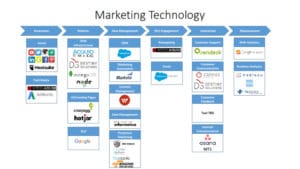
An Example of Marketing Technology Architecture


Why Intentional Processes Drive More Revenue

When many people think of process, they think of something mandatory. Usually something unpleasant. The idea of the “process police” comes up, a mysterious group who stifles any innovation in employees. We take a different view. We look at processes – intentional processes, those with purpose – as a potential competitive differentiator and revenue driver. In this case the meaning of “intentional” stresses the awareness and desire for an end to be achieved. You can intend something without necessarily being intentional!

We recently met with a senior executive from a notable FinTech company. Our discussion turned towards the need for process improvement, without also being “process for process sake.” We talked about the flow-on effects caused by poor processes. It’s a subject near and dear to my heart, having designed and implemented various processes  for technology companies for over 20 years.

The Sales Process

The most obvious process that’s tied to revenue is the sales process. How to turn an interest into a prospect and into a deal. There are many sales methodologies and processes out there, and we’ve used several of them.

Where things often fall down are in other areas. Renewal business. Product development. Implementation services. Support and customer success. Each one may in itself seem complete, but they frequently don’t connect with others. They are developed at the departmental level in silos. Intentional processes go beyond silos.

So why would a great, intentional process lead to more revenue? This diagram explains the logic:

intentional process

Processes without Intent

This all makes sense, but to illustrate the problem further let’s assume processes are “not intentional” in a number of areas:
– Sales processes are unclear or convoluted, leading customers to go elsewhere
– Renewal processes are vague, and customers are contacted too late, often risking the deal (or requiring a larger discount)
– Product road maps are inconsistent, confusing salespeople as well as customers
– Product commitments are difficult to keep
– Product development is late, buggy and/or canceled, frustrating customers and creating doubt in the company’s commitment to them
– Services processes are ambiguous leading to unclear deliverables and less value provided
– Support processes reward ticket closure rather than problem resolution
– Finance and Legal processes are onerous, delaying and risking product and services deals

The end result is wasted time and frustrated customers. Too much time is spent getting things done that could be better spent driving more business. Deals, renewals and additional business are at risk. And getting a recommendation from frustrated customers is also at risk.

Every Company Can Improve

Consider these three points:
1. Every company needs to improve in one or more areas.
2. If you’re only as good as everyone else you’re not better. You need to be better.
3. If you don’t have intentional processes you are leaving money on the table.

Process and Pragmatism

We take a pragmatic approach when working with clients. If they’re a smaller 50-person firm, a process might be simpler and carried out by a few people (or a single person) with minimum hassle. You don’t need many steps in the process, yet at the same time some level of definition and clarity is desired.

By creating an intentional process you are able to track the results of the process quantitatively as well as qualitatively and will get a consistent result. Without a process you’re dependent on “tribal knowledge” and the experience of the person performing the task.

If the customer is larger, there may be more required stakeholders and also more complexity. In a large public company, a product approval process is more than one person saying “yes”. It may involve multiple approval levels and signoffs as well as other inputs and outputs. At the same time, you don’t want to make it too complex.

There is a temptation to overengineer processes, especially by people who are too close to the problem but not close enough to the solution. I’ve found that’s where engaging a third party can be helpful to look objectively and unemotionally at the issue at hand.

Leadership vs Management

Management vs. Leadership – Setting the Foundation

Establishing the importance of leadership and management in building a high performance culture

“Management is about persuading people to do things they do not want to do while leadership is about inspiring people to do things they never thought they could do.” Steve Jobs

The ability to survive and thrive as a true market leader in today’s mature market and tough economy is achieved by leaders’ abilities to create and sustain an entrepreneurial culture of empowerment, discipline and personal accountability.  Focused leadership with a defined plan and disciplined actions is essential to creating winning teams and performance acceleration through effective coaching, mentoring and performance measurement.

Every aspect of the business – hiring and onboarding new associates, acquiring, growing or renewing revenue and solutions within an existing customer – is positively or negatively affected by leadership quality.

The need for leadership involvement, guidance and feedback is critical to ensure that best efforts and results are executed in every interaction with the customer. Individual and team coaching is critical to overall success.  I will discuss in detail the criticality of being and effective leader to accelerate growth and a world class performance culture.  Let’s start with the fundamentals.

Leadership vs. Management

Managers and leaders are two very different types of individuals. Manager’s goals arise out of necessities rather than desires; they excel at diffusing conflicts between individuals and departments, placating all sides while ensuring the day to day business gets done.

Leaders, on the other hand, adopt personal, active attitudes towards goals. They look for the potential opportunities and rewards that lie around the corner, inspiring subordinates and firing up the creative process with their own energy. Their relationships with employees and coworkers are intense, and the working environment is often, consequently chaotic.

We need both managers and leaders to survive and succeed. We must find ways to train good management skills and develop leaders at the same time. Without a solid organizational framework, even leaders with the most brilliant ideas may spin their wheels. But without an entrepreneurial culture that develops when a leader is at the helm, we will stagnate and rapidly lose competitive power.

We need both good management and leadership skills to survive and succeed. Without a solid organizational framework, even leaders with the most brilliant ideas may spin their wheels, frustrating coworkers and accomplishing little. But without an entrepreneurial culture, our business will stagnate and rapidly lose our unique competitive position.

Today’s Take Charge Leader-Manager

Take Charge Management is the integration of principles of great leadership combined with management fundamentals in a new pragmatism is critical for success in today’s market. I am by no means debating that some of the new ideas hyped to today’s leader/managers are without merit or that managers should go back to the bureaucratic practices of the past. Instead, I am saying that the time has come to reconsider the relative balance between innovation and fundamentals.

Today’s take charge leader-manager must excel at three critical areas:

  • Direction setting
  • Aligning people
  • Planning and budgeting.

Today’s take charge Manager’s ideas should be:

  • Adopted only after careful consideration and judged by their practical consequences
  • Purged of unnecessary buzzwords and clichés, tied to the here and now and rooted in genuine problems
  • Adapted to particular people and circumstances and adaptable to changing circumstances
  • Tested and refined and discarded when they are no longer useful.

Rick_Nichols_200x200-white

Rick Nichols is Managing Partner of TechCXO’s Sales & Marketing Practice and a member of the Executive Committee. He can be reached at rick.nichols@techcxo.com or view his full bio.

Sales Planning Guide: How to Build a High-Performing Team

Sales Planning Guide: Strategies for Success

This time of the year is critical to Chief Sales and Revenue Officers. So many things to do, so little time to do them:

  • Close Q4 business
  • Design sales model changes
  • Review individual and team performance
  • Top-grade talent
  • Assign accounts and territories
  • Review and refine sales compensation

This is a multi-part discussion on how to organize and motivate your sales team for success in the coming year.

Creating a great sales compensation plan is critical to focusing and motivating the sales team for success. It’s both a science and an art and – as they say in the movies – it’s complicated. Designing sales compensation plans are a delicate balancing act that should both motivate the team to maximize results while constructed in to allow the business to easily scale without breaking the bank.

Considering the following factors in sales planning and plan design will ensure a much higher probability of success:

Model revenue, performance and quota assignment

Corporate Revenue Goal Alignment

One very significant exercise involving sales, finance and HR is, before designing the upcoming plan, to agree on expected revenue objectives. Sales and finance should have equally weighed inputs and perspectives. Tension may occur when, totally apart from sales, finance creates a revenue and sales model that, while aligning with Board/Investor/CEO level growth models, isn’t aligned with market conditions and reality.

Team Performance and Quota Assignment

This exercise should be followed by analysis of current team performance. Systematic issues to consider in forming and finalizing both team and individual plans are current year performance, team turnover, onboarding time to full productivity for new hires and quota over-subscription.

Blaming underperformance solely on sales execution is common. Many factors contribute to underperformance including pricing and commercial terms, product quality, market climate and competitive threats.

Team turnover, time to hire and onboarding time to full productivity should be factored and balanced against quota assignment. The most current industry reports related to sales team performance state that current team performance is that roughly 60% of team members achieve or exceed quota expectations.

Factor in expected turnover and time to full value for new hires in modeling quota assignment. The “I hire industry thoroughbreds with great networks that can have instant success” and “let’s just increase our current reps’ quota” mantras and mentality simply doesn’t work.

Significant quota over-assignment should be factored – in the range or 30% – 50% to ensure a high confidence in sales revenue objective achievement.

Create an Aggressive but Balanced Plan

A sales-minded CEO that I worked for early in my career stated very simply, “You can’t have a healthy bottom line without a growing top line.” Many companies whose culture is dominated with a finance and/or engineering mindset and mentality consider sales a necessary evil. The facts are simple, pay too little and you won’t attract top performers, pay too much, it’s not sustainable for the long term.

Many of today’s successful sales compensation plans are modeled on a 40%/60% or 50%/%50% mix of base salary vs. on target earnings. Depending on situation, one may work better than the other. The premise with this is to have a balanced risk/reward between the company and the individual.

Keep it simple

Very simply, human nature and psychology says that people are motivated by what they’re rewarded to do. I get migraine headaches when I read compensation plans that are over a dozen pages in length, have very broad objectives and definitions of products, solutions and require a degree in calculus to calculate commission payments.

Plan objectives should be aligned with corporate objectives, clearly defined, standards for performance, aggressive but realistic, directly related to what they’re being paid to sell and how and when they’re getting paid.

Role-Based Compensation

Compensation plans should be very specifically aligned with the team’s and individual’s role within the company. Lead/demand generation, inside sales, outside direct sales and channels all have unique and different objectives, behaviors and revenue producing goals.

The quickest way to destroy sales focus and performance is to create a generic but overly complex plan that both confuses and frustrates individuals from their primary role of revenue generation.

Reward Over Goal Performance, Revenue Type and Quality

Rewarding revenue type, quality, timing are significant factors in motivating the team for success while accomplishing corporate revenue objectives.

Revenue Type

Revenue type is important, particularly in balancing new customer acquisition, growth and retention. Many plans make the mistake of paying one rate, regardless of which of the three revenue types are involved.

New business acquisition and significant customer expansion (new major solution sales, major customer expansion, e.g., additional divisions, distribution centers, and so forth) are very important to long term growth and scale. Additional seats, servers, devices, services and other incidental and ancillary services in most cases are handled by and paid to either account management or client success roles.

Revenue Quality

Profitability of revenue is important as, with significant discounting, individuals both give away revenue and set a precedence for the longer-term relationship with customers and longer term corporate health. Significant attention should be paid to addressing both revenue profitability and discounting policies within the sales compensation plan.

Revenue Timing

Revenue timing is important for several reasons, the most important being overall corporate financial health, as well as staffing and utilization/realization of services and support resources.

Rewarding the sales team’s and individual’s ability to accurately forecast revenue, especially coinciding with month, quarter and year end should be rewarded over and above normal commission percentages. Bonuses, SPIFs and other time-based rewards are very simple, straightforward ways to reward behavior and achievement.

Over Goal Compensation

The target of any well-constructed plan should be to reward over-goal performance and motivate the highest population to be rewarded for exceptional achievement. Many plans are modeled with significant commission accelerators as well as other non-cash incentives such as equity and stock or club trip performance. Many companies incorporate a quota club reward as well as Chairman’s or President’s Council for the top 10% of the team. Stringent definition and levels of performance for these rewards should be outlined in the plan.

Regardless of how you structure your sales team’s commission plan, never — under any circumstances — place a cap on earnings and variable compensation. Doing so will remove individuals’ and teams’ incentives to “do whatever it takes” as well as create an under-performing sales culture and kill team morale.

In closing, sales compensation plans, in combination with a well thought through sales model, should be designed to attract and retain top tier talent, lower the cost of fixed cost investment in salaries, and accelerate healthy and profitable growth.

Term Sheets

Congratulations.  You’ve made a compelling case for your company to receive funding, investors are interested, they’ve done a couple of rounds of due diligence and probably visited you and your team at your site – if there is one.

Next step is a Term Sheet.  Here are the pressure points within the term sheet that you and your lead (such as TechCXO) need to be prepared for:

Leverage

The simple truth is that your early-stage investors typically have more leverage than you.  They look at hundreds of deals and fund a handful.  However, you’re not necessarily weak.  Having interest from multiple suitors greatly strengthens your hand.  Just remember not to dig into your position too hard.  Investors are used to walking away from deals and you want that capital.  Word travels fast in this small community, too and you don’t want to be cast as a hard case.

Ownership

Our guidelines remain: no more than a 25% equity for investors in the Angel/Seed Round and no more than 30% equity in the Early VC or Series A stage.

Valuation

Using traditional industry comparables as you would for M&A transactions is tricky for start-ups.  Generally, the more mature your company and its metrics, the better the valuation.  Some metrics such as cash flow and revenue may apply.  Some metrics may not be available and you will need your Structure and Performance hurdles to aid valuation.  The assumptions made and agreed to within those hurdles such as customer acquisition, revenue, retention, profitability, etc. will help set your valuation.

Board Composition

One to two Board seats to investors is the norm. There is an increasing trend of an equal number of board seats going to independent members, with the founder/CEO as the “odd” member of the new Board.

The Option Pool

The purpose of the option pool is to provide incentive for management, key employees, and advisors. This range can vary based on how many of the management members are also founders and have founders stock.

Many firms provide options for all early employees – typically under the assumption that they are being paid below market cash compensation and are in a volatile employment environment. With each new raise, the option pool is refreshed to ensure that there are adequate incentives for key new hires.

For stock option plan composition, a good rule of thumb is for 15-20% of the capital structure reserved for the option pool at this stage.  Even better is if you can get this post-closing, so the new investors and founders share in the dilution.  With further rounds of financing, this pool may get down to 10%.    Target half of the pool for the leadership team (CEO, Board Members and direct reports to the CEO).

Key Rights and Preferences

Rights and preferences can get you down into the weeds. You’ll certainly need advisors to help you sift through this. Here are some quick highlights:

  • Liquidate preference – usually 1X original investment
  • Participation – conversion to common after the payment of the liquidation preference in order to “participate in the remainder of liquidation proceeds”
  • Anti-dilution rights – to protect against future issuance of equity securities at a price below the price the current investors are paying
  • Board of Directors participation – either board seat or observation right depending on the size of the investment and % of the company owned post investment
  • Veto rights on certain corporate transactions – preferreds vote as a separate class on things like senior debt, issuing additional securities, liquidation
  • Information rights – monthly/quarterly/annual reporting of financial results to investors
  • Registration rights – ability to register shares in the event of a public offering

Structure and Performance Hurdles

The primary questions to be answered are: how big is your market and how much of it can you capture…and in what time frame.  This is why we stress defining market niches so much during your preparation for funding. Other considerations such as the development of new applications and adding key team members can be factored in but there’s no getting around competing and winning in your defined market.

The Power of Compound Decision Making

CEOs of private, mostly venture-backed growth companies know all too well the burden of high expectations, both in the milestones and scale they are trying to achieve. Attached is Part 1 of “The Power of Compound Decision-Making” – a management piece that I hope will stimulate productive thoughts among aspirational business builders and leaders.

Power of Compound Decision Making (Part 1)_Viraj Parikh_TechCXO

  • « Previous Page
  • 1
  • …
  • 11
  • 12
  • 13
  • 14
  • 15
  • …
  • 19
  • Next Page »
TechCXO Logo-Reversed
About TechCXO

People
Clients
Contact & Locations
News

Executive Focus

Executive Leadership
Finance
Human Capital
Product & Technology
Revenue Growth

Newsletter
TechCXO HQ

3423 Piedmont Rd., NE
Atlanta, GA 30305

LinkedIn (opens in new tab) YouTube (opens in new tab) X (opens in new tab)

Copyright 2026 TechCXO
Privacy Policy | Accessibility