
• Insights
  • Careers
  • Contact Us
TechCXO-Logo
TechCXO Home Page Logo
  • Fractional Leadership
        • Fractional Leadership

        • Chief Financial Officer (CFO)
        • Chief Executive Officer (CEO)
        • Chief Operating Officer (COO)
        • Chief Technology Officer (CTO)
        • Chief Product Officer (CPO)
        • Chief Information Officer (CIO)
        • Chief Marketing Officer (CMO)
        • Chief Information Security Officer (CISO)
        • Chief Sales Officer (CSO)
        • Chief Revenue Officer (CRO)
        • Chief Human Resource Officer (CHRO)
        • Chief Customer Officer (CCO)
        • Chief Artificial Intelligence Officer (CAIO)
        • Executive Team Coaching
  • Services
        • Services

        • Capabilities

        • Services

        • Executive Leadership
        • Finance & Accounting
        • Human Capital
        • Product & Technology
        • Revenue Growth
        • Capabilities

        • Private Equity & Venture Capital
        • AI
  • Industries
        • Industries

        • Business Services
        • Consumer & Retail
        • Energy & Power
        • Financial Services
        • Healthcare & Life Sciences
        • Industrials
        • Media & Communications
        • Real Estate
        • Technology & Software
  • Resources
        • Resources

        • Blogs
        • Guides
        • News
        • Case Studies
  • About Us
        • About Us

        • Contact Us
        • History
        • People
        • Locations
Schedule a 15-Min Call
Search field required with a minimum length of 3 characters

Where Does Growth Come From?

What is the one thing used to defined success for investors, Board members and executive leadership teams?

ANSWER: INCREASED ENTERPRISE VALUE.

If you can increase enterprise value, almost everyone associated with the organization will be happy.  It’s like the expression in sports that winning cures alls ills — increased enterprise value cures (most) ills.

So, what’s the secret to increasing enterprise value? No secret at all, really.

Sometimes we make things far too complicated in business.

The simplest explanation of how to increase enterprise value is that value comes from (organic) growth and growth comes from revenue.
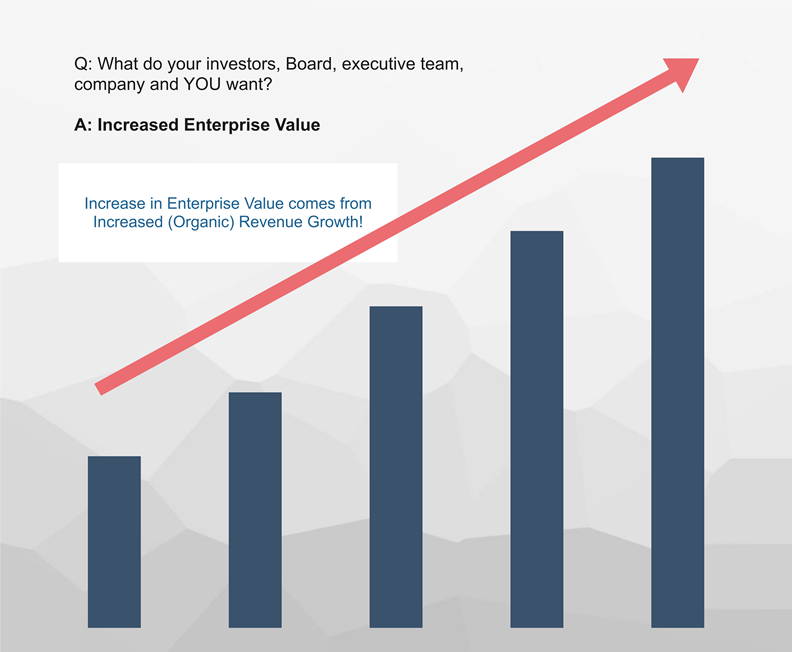
Increased Enterprise Value comes from increased revenue growth

Where does Revenue Growth come from?

The next logical question then is, Where does revenue growth come from?  The question is so fundamentally straightforward it almost seems stupid…

But… you would be amazed at the responses you get — from even the most senior sales and marketing people — try it!  Ask someone: Where does revenue growth come from?

They might say…

“Sales”…

“Leads” …

“Sales qualified leads” …

“Signed contracts”…

“Paid invoices”….

Organic Revenue Growth comes from 5 places

The truth is to (A) Produce Revenue and (B) Achieve Growth, there always has been and always will be five (5) places and five places ONLY of origin.  Here they are:

  1. Create More Opportunities

  2. Execute More Effectively Against Those Opportunities to Convert them to Bookings

  3. Ensure Customers Achieve Success (a.k.a. they achieve business outcomes for which they purchased your product or service)

  4. Stay Longer, Buy More

  5. (Customers) Advocate for the Brand and Solution
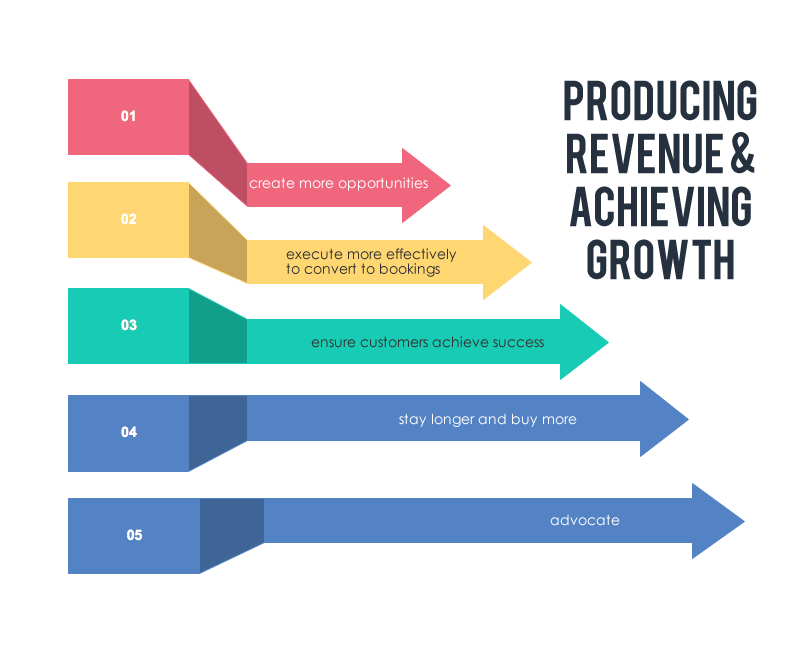
Revenue growth only comes from 5 places


Shall we break it down to even more essential elements?  How about the sources of opportunities?  What are they?

The 5 Sources of Opportunities

They are: Sales. Marketing. Partners. Referrals. Customer Success.

Beginning with Marketing, a world-class marketing effort provides 30% of qualified opportunities into the pipe.

The sales organization has to generate its own sales opportunities to the tune of 40%.


5 Opportunity Sources

The 5 Opportunities Sources


Depending on the business structure and distribution, Partners can provide 0% to 50% but let’s use 10%, as that’s an industry standard.

Referrals are 5% and then Customer Success is 15%.  The distinction with Customer Success is that it comes from post-sales implementation and support.  These opportunities close much faster than do marketing qualified leads.

Why Does Organic Revenue Growth Remain So Difficult to Achieve?

So if you can break down (1) Enterprise Value; (2) Define Where Growth Comes From; (3) Define Where Opportunities Come From, why does organic revenue growth remain so difficult?

The short answer is “Gaps.”

There are lots of areas for potential breakdowns or gaps within strategy, market, product/market fit, sales strategy, planning and execution and customer success.

Right now you may be thinking about specific issues, such as “the quality of our leads is bad” or “adoption for our platform is not what it needs to be.”

Maybe you have been treating Customer Success in a traditional sense, that is “Customer Success” was delivered via Professional Services (Onboard, Train, Deploy, Enable) and Customer Support (Tickets, Response and Resolution) but it has not become a source of new sales for you in terms of expanding, renewing, cross-selling or upselling your products, services or platform.

The truth is, your revenue generating efforts can break down or not be optimized in dozens — maybe hundreds — of areas.

Wherever there are breakdowns or inefficiencies you are not optimized.  The good news is, you can already identify the breakdowns yourself, such as: “Our product/market fit is off.”  “There’s a disconnect between what marketing says is a qualified lead and what sales says is a qualified lead” and on and on.

The difficulty, of course, is identifying the specific areas to attack, including defined KPIs (Key Performance Indicators) appropriate for the function, your company and your industry. However, if you can begin by embracing sales as an interconnected system, you are on your way to having a repeatable, comprehensive revenue generating machine.

Here are three maxims to hold:

  1. Revenue production and growth are optimized by aligning Strategy, Messaging, Product, Marketing, Sales, and Customer Success Strategies and Execution.
  2. Companies struggle to manage all go-to-market activities that produce revenue including markets, products, content, messaging, accounts, leads, opportunities, pipeline, conversions, bookings, revenue, customer success, expansion, and advocacy.
  3. A systemic, repeatable, measurable end to end approach can be implemented that will accelerate growth and enterprise value creation.

Connecting Revenue Growth and Enterprise Value

Let’s connect the dots to our original question: How do you make your Board, investors and organization happy?  The answer is increase Enterprise Value through (organic) Revenue Growth.

How much increased value does incremental increases in revenue create?  Well, there are many variables depending on industries.  For example, a SaaS-based company with a recurring revenue model may enjoy large multiples of 10x or more. The same might be true for companies in hot spaces like mobility, IoT, health care, etc.

But, as a rule of thumb, you can anticipate that an incremental revenue increase of $2.5M can create anywhere from $7.5M to $17.5M (or $25M at 10x multiple) in enterprise value.  Obviously, for smaller companies, that $2.5M is much more impactful to overall valuation.

Incremental Revenue to Enterprise Value Table

The point is, if you can increase organic revenue growth at significant levels, you can increase your enterprise value to the delight of your Board, investors and entire organization.
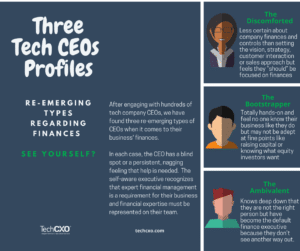
 

Three Profiles of Tech CEOs

In technology, three CEO profiles continually present themselves when it comes to the handling of finances.   In each case, the CEO has a blind spot or a persistent, nagging feeling that help is needed.  The self-aware executive recognizes that with rapidly changing business models and dynamics, expert financial management is a requirement for their business and financial expertise must be represented on their team.  However, their hesitancy continues.

Do any of these sound like you?

  • The Discomforted – This executive is less certain about company finances and controls than setting the vision, strategy, customer interaction or sales approach but feels they “should” be focused on finances.
  • The Bootstrapper  – Many founders who have created their businesses are totally hands-on and feel no one know their business like they do. These executives are rarely adept at the fine points, such as finding new sources of capital or know what equity investors want.
  • The Ambivalent – This CEO knows deep down that they are not the right person to be overseeing finances but “doesn’t know what they don’t know” and therefore have become the default finance executive because they don’t see another way out.

View the Infographic Now (PDF)

Tech CEO

Tech CEO Profiles Re: Finances

Increasingly, CEOs are outsourcing the finance function on a project, part-time or interim basis to an experienced CFO who often brings highly specialized skills to his/ her assignment. Depending on the circumstances, it may be more efficient and cost-effective to bring in a hired gun.

This approach affords CEOs the flexibility to bring someone on without incurring significant overhead.  Consulting contracts usually have very short termination periods and help avoid recruiter fees,  too.  Thus, CEOs can tap their network to not only find someone quickly and cost-effectively, but they may even be able to find someone with highly specialized skills to help solve their current issues.

To learn more about how to make these part-time and interim arrangements successful, click on the book image to download a free eBook on: The Outsourced CFO: A CEO’s Selection Criteria.


Board Compensation Public-Pre-IPO

Compensation for directors of large U.S. companies just passed a new threshold — $300,000 per year in total fees — up 3.5% according to a new study by Compensation Advisory Partners.  Median pay for non-management partners is up from $290K last year.  While large companies rely mainly on annual retainers (cash and equity) to compensate large company directors, according to the report, smaller public companies and startups have different structures and significantly lower compensation levels.

Large Company Board Comp vs. Small Public Companies and Startups

How does big company Board comp compare to independent directors for startups, early stage companies and smaller companies? According to Chris Thomajan, TechCXO’s Managing Partner in Boston, and author of Board of Directors Management Guide for Startups, startups and smaller companies compensation are considerably lower.

“Early stage companies should expect to pay $2,500 per meeting or $10,000 per year to your independent directors. That number increases the closer a company gets to an IPO and can be in the range of $30,000 per year for pre-public or public companies,” said Thomajan.  “Distinctions are also made for the specific role of a director. The chairman of the board or someone with relevant scientific or financial expertise like an audit committee might be paid more than a regular director.

“Independent directors also expect to receive equity grants along with their cash compensation. The amount and frequency of such grants also varies by the stage of the company. However, an early stage company should expect to grant 0.1% to 0.25% of equity with a vesting period of 2 to 3 years. Additional annual grants are also expected,” Thomajan added.

Thomajan also said that unlike a company’s officers, such as a CEO, and their investors who sit on your board, independent directors are typically paid a combination of cash and equity for his/her services. There are several ways to structure the cash compensation, but in general, the director is either paid a flat fee per meeting or a flat fee per year (paid quarterly) that assumes a certain level of commitment.

He also said that while there is a cost to bringing on non-investor board members, the potential benefits far outweigh those costs.

CSMs vs. Sales – The Same Only Different

CSMs and Sales Reps Share More Similarities Than You Think

When you are with a group of CSMs, the word “Sales” often incites contorted facial expressions, bad jokes and inevitably the analogy of the “used car salesperson”.

Although sales jokes might be funny while having a drink with your CSM buddies after work, that perception is for the most part misguided.  Keeping it real, there are indeed sales reps that are deserving of the “used car salesperson” reputation, and we have all encountered them.  Fortunately, those types of sales reps are few and far between.

I was a CSM (aka customer advocate, account manager) for several years early in my career.  Since then I have worked with, interacted with and trained hundreds of CSMs.  When I ask a CSM to identify someone they consider to be a good sales rep they have worked with and why, they typically recall a sales rep who genuinely cared about his/her customers, followed by a list of attributes they like about that rep.  That list of attributes will invariably be similar to the following:

“Jennifer understands the business issues our solution solves; she understands the customer’s needs; she sets proper expectations with the customers regarding the capabilities of our solution and timeline for implementation…”

CSMs and Sales Reps Utilize Similar Skills

The people in your company who interact with your customers the most (CSMs), and who have (directly or indirectly) the most significant financial impact on your bottom line, have most likely never been trained in customer interaction and persuasion skills.

Most CSMs do not consider themselves salespeople in any way, shape or form and have no desire to become a sales rep.  Yet the most effective CSMs leverage many of the same skills and sensibilities as today’s effective B2B salespeople.

Successful CSMs help their customers achieve desired outcomes by engaging with the right people at the customer, provide timely guidance and convincing the customer to follow a proven, successful path to achieve specific outcomes, even though the customer may want to take a different path.  To persuade the customer to follow a particular path, the CSM must have credibility and finesse.  The customer engagement skills utilized by successful CSMs include:

  • Building relationships, up and across the customer organization
  • Gaining trust
  • Articulating value
  • Influencing the customer
  • Guiding the customer through a defined process
  • Continually moving the ball forward to the desired outcome

Guess what?  Those are precisely the skills successful B2B sales rep uses to move a prospect down a sales path to achieve their desired outcome, a signed contract from a new customer.

CSMs Come From a Variety of Backgrounds… But NOT Typically Sales

Most CSMs moved into the CSM role from an operational area such as support, professional services, marketing, development, etc.  Right or wrong, most CSMs do not follow the path of moving from a sales role to a customer success role.

As a result, most CSMs have never been trained on the customer engagement and persuasion skills outlined above.  Yet, CSMs likely have more interactions with your customers than anyone else in your company.

CSMs are Your Customer’s Primary Point of Contact

Let that sink in for a moment…the group of people in your company who interacts with your customers the most, and the group who has (directly or indirectly) the most significant financial impact on your bottom line has most likely never been trained in customer interaction and persuasion skills.

That should change!

What is the Solution?

Invest in the right skills for your CSMs.

As a practitioner and advocate in the Customer Success industry and a firm believer in investing in your people, I cringe when I see companies put their team members in the highly impactful role of a CSM without the proper training, especially given substantial revenue impact of the CSM team.

If you manage a team of CSMs who are proficient at the customer engagement and persuasion skills outlined above, you are one of the lucky few.  If your CSM team has not been trained in customer engagement and persuasion (aka sales) skills, I highly recommend you get them professional training on these types of skills ASAP.  More precisely, I do not recommend you train your CSMs on the latest sales “methodology”, but train them on the fundamentals of customer engagement and persuasion.

Coming up next… The Customer Engagement and Persuasion Skills CSMs Proficiency; CSMs Potential Impact on Revenue, Churn and Customer Satisfaction.


Goocher

Bill Goocher TechCXO Partner and Customer Success expert

Bill Goocher leads TechCXO’s Customer Success practice as Partner, Customer Success.  In this role, Bill and his team provide fractional executive and strategic consulting services related to Customer Success.  Additionally, Bill leverages his combined experience in Customer Success and Sales to conduct onsite CSM Engagement & Persuasion/Sales Skills workshops customized to the unique needs of his clients.  Bill can be reached at bill.goocher@techcxo.com, 727-773-1121 (m).  You can view Bill’s full bio here.

Female Founded Startups

TechCXO continued its leadership in assisting female founded startups

TechCXO is dedicated to supporting female founded startups as they set a foundation for success by building best practices and infrastructure; access capital, customers and ecosystems; and accelerate revenue, product and market expansion.  Startups do this through a variety of TechCXO services, including Finance & Operations support from our CFOs; Sales & Marketing support from CSOs and CMOs; and Product & Technology support from CTOs and CIOs.

According to Crunchbase News, 2018 set at an all-time high for investment dollars into female-founded tech companies. In 2018, $38.9 billion was invested in companies with a female founder, representing 17 percent of venture dollars funded globally. Investments in 2018 came close to doubling the amount recorded in 2017, a year that saw $19.8 billion invested into companies with at least one female founder.

The following is a partial list of female founded startups we’ve assisted, the industry and cities in which they operate, who the TechCXO partners are who have, or are, supporting them and any additional notes on the companies’ success.

Business Plan Advice from Yale – Dumb it Down

The best advice I ever received on writing business plans may have also been the most obvious.  The advice came from David Cromwell, a 30-year veteran at JP Morgan. For 6 of those years, he was the CEO and President of JP Morgan’s Private Equity division. He is now a professor at the Yale School of Management. Since my time at Yale, I’ve used his insights into writing business plans with great success.

He said, “Investors all have one thing in common: they invest in ideas that they understand. And, great ideas that are communicated poorly in business plans don’t get funded.” So, your success or failure hinges on how effectively and efficiently your business plan translates your idea.

Keep in mind that the sophistication of investor audiences varies greatly. The investor that loves your business plan could be a multi-billion dollar Venture Capital (VC) firm with a hundred MBA-type Analysts that pour over 30 business plans every day. But, your investor could also be an Angel investor that dropped out of high-school and made 7 million dollars over 30 years in the plumbing business.

So, remember this with every stroke of the keyboard as you create your business plan. Write the plan for every audience (the self-made Plumber Angel and the VC Analyst). If you write it such that only the VC Analyst can read it, you lose any chance of attracting the Angel. But, if you write it such that the Angel can read it, you actually make it easier for the VC Analyst to understand your plan versus the other 29 plans they read that day.

To illustrate the point, read the following two paragraphs and decide for yourself which language will appeal to the most investors.

“Given the stabilization of both the macroeconomic environment and the recent increase in the willingness of commercial lenders and financial institutions to provide capital, our conjecture can only be that pursuit of this venture not only has merit, but also is timed appropriately. Our deep operational experience and tenure in this industry provides the foundation and aptitude to assure superior returns and superlative results.”

versus

“The economy is improving. Banks are lending again. The time is right to launch our company. We are absolutely the industry experts and are certain of our success”

Here are 4 ways to make your business plan readable for every audience. It is going to sound very elementary, but I promise it will make every bit of difference in your plan. First, I’ll lay out the 4 principals and then I’ll provide you with an enormously valuable tool to help you measure the readability of your plan. When writing your plan:

  1. Use shorter words versus longer words. Stick to basic language.  Words with more than eight or ten letters slow readers down and detract from readability.
  2. Use shorter sentences versus longer sentences. Sentences should be no longer than ten, or so, words.
  3. Use fewer sentences per paragraph versus more. This makes for crisp reading and reduces monotony.
  4. Use simple, familiar words to describe your industry and product. Impressive-sounding “MBA” terminology and industry jargon greatly detracts from readability.

A very useful, but little-known tool in Microsoft Word is the Grammar and Readability statistics. You can learn how to enable and use this tool here. Once you complete spell-check, the Readability statistics are displayed and show metrics like “Average words per sentence” and “Average sentences per paragraph”, as shown below.

The most-useful indicator in the readability statistics is the Flesch-Kincaid Grade Level score. This score indicates the grade level education that a reader would need to read and understand your document. The lower the grade, the more readable the document. Believe it or not, Mr. Cromwell always pushed us to aim for a 7th grade to 9th grade level range! Any more than that, and you could lose the Angel investor. Moreover, the VC Analyst (who may have already read 29 business plans that day) could struggle to understand your plan and simply move on to the next.

Following all the advice above and using the tool won’t guarantee that your business plan will get funded. But, if you don’t follow the advice, you will artificially decrease your appeal to all possible sources of funding.

Best of luck to you with your business plan and your new venture.

P.S. The Flesch-Kincaid Grade Level score for this post is 8.8.

Why Most Acquisitions Fail (and How to Get Integration Right) Part 2

The Overlooked Key to M&A Success: Integration Leadership

Companies seek to accelerate revenue growth or enter new markets through mergers and acquisitions. They spend a lot of energy and resources identifying the right targets based on synergy and combined financial models.

But oftentimes, the real value of the acquisition is not realized. M&A typically fails during integration. All that effort and capital spent on acquiring the target is wasted.

In the area of Sales & Marketing, the acquiring company needs to identify the critical issues prior to the closing in preparation for “Day One.” Day One is an important milestone and should be well coordinated. It’s the best day to communicate to employees, the sales team, vendors and customers (in that order). My motto is always: “If you don’t communicate what is happening right away, they will make stuff up – and that’s always worse than the real story.”

At the heart of the merger is the story…not as stated in the press release, but as interpreted by existing and potential customers. What is the resulting value that the combined entity should contribute to the customers’ experience? Delivering this value should guide merging companies on 1) Marketing messaging and Alignment, 2) Sales Organizational Structure, 3) Go-to-market solution planning, 4) Channel Partner and Vendor Programs, and 5) Sales Incentive Plans. (There are a thousands decisions that must be made, but these are 5 of the most-critical). The Day One messaging must include compelling statements to provide assurances, generate enthusiasm and hope, and keep nerves subdued.

Marketing Messaging and Alignment:

What value is in the acquisition for current and potential customers? The combined entity is doomed to failure if an acquisition doesn’t create a 1+1=3 scenario. So, it starts with the messaging that will shape the picture in the minds of customers, partners, employees, vendors, and the marketplace.

See Part 1 – Why Acquisitions Fail

Day One messaging must include a very clear, credible, and compelling market promise. Acquisitions are a very anxious time for all stakeholders. And, this is no time for “good enough”. If the market promise is unclear…well, as they say, “if you don’t know where you are going, any road will take you there”. If the market promise is clear, everything else below is easier to create. So, take the time and be thoughtful here. If you need help, go and get it. And, get it long before Day One.

Sales Organizational Structure:

Are we merging sales leadership by identifying the best talent or are we subordinating the target sales team under our sales leadership? Either approach has merit, but it requires leadership and clarity at the highest level. The Market Promise will be a strong compass when making decisions on who will lead and the desired, resulting culture. Again, this is where an experienced (TechCXO) integration leader can be critical.

Many companies put off this crucial sales organization integration decision until days or week after the closing, creating disruptive sales force confusion which can lead to sales “stars” exiting on both sides. (I have worked on mergers, where the issue is never addressed by the leadership and left to the sales management to battle out – this is not a good approach.)

We recommend absolute clarity in announcing sales leadership during Day One, then including the sales leaders of both companies in the Integration Steering Committee.

Channel Partner and Vendor Programs:

Acquisitions are an especially anxious time for Channel Partners, Vendors, and anyone else (like a sales professional) who has an established territory. These stakeholders will defend, and rightfully so, the significant investments they made in the past and relationships they have established. When the merged entity depends on these stakeholders, navigating how future territory lines are drawn can be a political power struggle.

The Market Promise and strengths and weaknesses of these stakeholders will determine their ultimate role in the delivery of the expected value. And, many of these discussions and decisions can’t be made prior to Day One for reasons of confidentiality. Communicating to the critical Partners and Vendors is critical.

Sales Incentive Programs:

When acquisitions happen, sales professionals get nervous. And, most Sales People…hate change. The perception is that their job, their established customer base, and their opportunity to earn is all in jeopardy. In most cases, few promises can be made on Day One to quell these nerves. I’ve always said that the sales incentive plan drives the sales culture.

Fortunately, the acquisition integration risk in the area of Sales & Marketing can be greatly reduced by bringing on the right leadership. The partners at TechCXO specialize in being an acquisition integration lead executives. We can help you make a successful acquisition by providing hands-on, experienced on-demand executives who partner with the C-Suite, board and stakeholders to ensure the integration is given the leadership, skills and experience required for a successful merger.

Next, we will look at technology integration.


Why Most Acquisitions Fail (and How to Get Integration Right) Part 1

The Overlooked Key to M&A Success: Integration Leadership

Companies seek to accelerate revenue growth or enter new markets through mergers and acquisitions. They spend a lot of energy and resources identifying the right targets based on synergy and combined financial models.

But oftentimes, the real value of the acquisition is not realized. M&A typically fails during integration. All that effort and capital spent on acquiring the target is wasted.

Why? There can be several reasons:

1. Unless you are a large company that can afford their own in-house acquisition integration department, companies simply don’t have the internal resources to assign to an acquisition integration to do it right.
2. The existing management team fears creating a costly disruption in the acquired target.
3. The integration burden is placed on existing managers who already have a day job causing endless delay and lack of initiative.
4. The talent in the acquired firm is ignored and “stars” exit early, quickly causing a critical talent drain and loss of business know-how.

Every acquisition integration requires a dedicated, objective leader to achieve a timely and cost effective successful outcome. The leader must have the business acumen and soft skills to execute on the complex business objectives and strategy without negatively disrupting the combined organizations and their customers. It’s a careful balancing act that is learned from years of extensive experience.

TechCXO has on-demand executives that can lead your next acquisition integration.

The emphasis is on leader. An executive that can readily step-in, manage the various functions, communicate with the C-Suite, Board and management teams with confidence and execute.

The benefits of an interim executive to lead the integration are manifold:

1. The interim executive is not connected to either company’s political structure. He/she can speak freely, impartially and objectively about the problems. He/she will include and listen to the right functional leads on both sides. He/she will build needed relationships and trust on all sides to accelerate the integration.
2. The interim executive brings experience and best practices of completing acquisitions for other companies. For most clients, an acquisition happens every five years or longer and the internal talent lacks enough experience.
3. The interim executive has the experience to distinguish the real problems from the “noise.” Every acquisition or merger generates a tremendous amount of what I call “noise”: It’s all the supposed problems identified by employees in all functions at all levels of why the integration is going to fail. Most of it is rooted in cultural differences, feelings of resistance, lack of vision, fear of being excluded, organizational misalignment, geographic separation, to name a few. The experienced acquisition leader will collect all of the noise and identify the real problems in an atmosphere of inclusion and trust. Each acquisition is different and the real problems can exist anywhere inside the noise. The acquisition leader will engage and communicate with the organization to be effective in every situation.
4. The interim executive will also ensure that the customer experience is not negatively impacted. This is not easy, as you will have disparate sales, customer service, ERP systems, order management protocols and supply chains. Customers are always weary of mergers and acquisitions, but the consensus is that the customer experience never improves. You do not want to lose market share.
5. The interim acquisition leader will establish a timeline with hard milestones and report progress to a Steering Committee of carefully selected stakeholders (C-Suite, Board Members, Investors as appropriate). He/she will make sure that communication occurs at the right intervals and in real time. The acquisition executive will level-set the integration objectives up front: What do we want this integrated company to look like? An assimilation? A hybrid of best practices? A cost optimization play? The acquisition executive can advise the leadership on these decisions and develop the integration plan and timeline accordingly.
6. The interim executive has the ability to shape the integration around the complex acquisition objectives that drove the merger in the first place. Sometimes these objectives are highly sensitive in nature and should not be shared with internal managers (i.e, divestiture, cost reduction, geographic consolidation, liquidation of assets)
7. The interim executive will lead the teams and reduce the “human toil” and accelerate the average acquisition experience. The leadership is accomplished through influence or cross-functional reporting structures as appropriate. Every company culture is different.

The four important areas that a seasoned acquisition integration leader manages are:

1. Customer experience (communication, order management)
2. Creation of a joint sales force
3. Proper cadence of system integration (email, ERP, portals, platforms)
4. Managing the temperament of the leadership (CEO, CFO, Board, Owners, Investors) on all sides for the benefit of a successful, timely integration. This is where executive soft skills are crucial. The soft skills, the executive’s ability to lead organizational change and influence, are equally important, if not more important, than the hard skills.

One more note: Timing is critical. A successful integration requires preparation and a strong “Day One” execution. The integration executive should be brought in at least two weeks before the closing to prepare the organization for a successful kick-off.

CSOs and CMOs Must Hang Together

As recently as five years ago, few would’ve predicted the unification of Chief Sales Officers (CSOs) and Chief Marketing Officers (CMOs). They didn’t speak the same language, often with differing definitions of terms as fundamental as “what is a lead?” They fiercely competed for budget… the CSO wanting to hire more sales people and the CMO wanted to fund additional marketing programs. They blamed each other for shortfalls in revenue. The CMO was the creative type and the CSO was the customer relationship expert. Although they sometimes sat in adjacent offices, they couldn’t have been farther apart.

So, what has changed that will finally unite CMOs and CSOs? Answer…The buyers are back in control. Today’s post explains what this means and the four steps CMOs and CSOs must take (together) to stay relevant.

Five years ago, sales people had all the information that buyers needed. Buyers had to engage sales in order to get information and make informed decisions. Today, the proliferation and availability of companies’ product information on the Internet has put buyers back in the driver’s seat. Buyers today have seen your (and your competitors’) products on your website, read reviews on your company, seen a demo, downloaded white papers, attended a webinar, configured their solution, and probably reviewed pricing long before speaking with anyone from your sales team. In fact, many buyers, now referred to as Customer 2.0, have already made decisions prior to speaking with a single sales person.

So, how does sales and marketing get re-engaged with Customer 2.0 and influence the buying process? CSOs and CMOs have now been forced to work hand-in-hand to remain relevant to buyers, follow the buyer’s journey through the buying process, and find ways to influence the buyers though their exploration. Here are the steps they are taking, together.

Step 1 – Gaining visibility into this new buying process

Marketing Automation tools like SilverPop, Pardot, Eloqua, and Marketo, combined with sales automation tools like Salesforce.com give companies the ability to track a buyer’s journey through this new buying process. The tools detect every click on your website, every white paper the prospect downloaded (from your company), every email they opened, every webinar and demo they registered for, as well as all the interactions with your sales team. And they do this for every prospect that in some measurable way engages with your company.

The thirst for customer data and the loss of the buying process control is forcing CMOs and CSOs to work together to find budget to purchase these analytics tools and sit together to agree upon a common language to understand what the numbers are saying.

Step 2 – Understanding Customer 2.0 buying behaviors

CMOs and CSOs must cooperate to understand the behaviors and activities that buyers undertake during their buying journey. Which content on your website is popular? Why do customers stop interacting with you as a result of seeing your online demo? Which are the common sets content and interactions that led to a purchase for a particular vertical industry? When is the appropriate time to introduce a sales person?

The aggregate buyer behavior intelligence and analytics from the marketing and sales automation tools are amazing. And while the dashboards are awesome, CMOs and CSOs have to really roll their sleeves up and get dirty in the data to really understand what’s going on, especially early in the learning process.

Step 3- Build campaigns, content, and tools that attract buyers

The content needed to attract Customer 2.0 is much different than the content of yesteryear. These buyers don’t want to be sold to. They want to learn and they like learning through webinars, podcasts, twitter, videos, blogs, and thought leadership content. They want to understand best practices and how other companies are solving their problem. CMOs and CSOs must co-create budgets to fund these campaigns, content, and tools. They must work together to build, test, and determine when is appropriate to deliver which piece of content to customers, based on their behavior.

Step 4 – Processes and execution

CMOs and CSOs must create much tighter linkages and effective handoffs between sales and marketing teams. And, they must consort to change all the marketing processes, sales processes, forecasting methodologies, manager coaching practices, etc., etc., etc.  They must change the working relationship, language, and communication between their teams. Leveraging both the new content and the marketing and sales automation tools, they must work together to proactively engage with Customer 2.0, influence them, create and nurture the opportunity, and close the deals.

The bottom line

Changes in buyer’s behavior and the necessary tools needed to compete for and attract buyers have created an environment whereby CMOs and CSOs must now work in resplendent harmony. Failure to do means certain failure to attract and keep customers over time. Customer 2.o is here to stay. So, I sure hope the CSO and CMO like the person in the office next door.

Question: What are you seeing that demonstrates this new buyer behavior? Have you noticed your CMO and CSO burying the hatchet and collaborating?

Why your sales team stinks at forecasting – part 3

Re-Qualify and Reclassify Every Deal

In Part 1 of this series, Here’s why your Sales Team Stinks at Forecasting Revenue, we reviewed the facts about just how bad we are at forecasting, thought through “why we stink,” and outlined three steps to redeeming ourselves as sales professionals and leaders. In order to help companies dramatically improve forecasting, we must:

  1. Review and re-define the qualification criteria and sales pipeline stage definitions that are at the heart of weak pipelines and poor forecast accuracy. (Covered in Part 2 of this series)
  2. Re-qualify every deal, reclassify the deals based on the new sales stage definitions, and clean out the rubbish…and methodically apply these criteria in real time, forever. (Covered in this post, Part 3)
  3. Create a new sales culture and cadence that focuses the majority of discussions around building strong pipeline, rather than forecast.

In this post, Part 3, we re-qualify every deal, reclassify the deals based on the new sales stage definitions, and clean out the rubbish…and methodically apply these criteria in real time, forever. I’ll walk you through the steps needed to implement the new stages, discuss how to avoid two major implementation pitfalls, and review why It will totally be worth it!!

techcxo-sales-forecasting

Clear out your sales rubbish by re-qualifying and reclassifying all deals

Cleaning out pipelines is just like cleaning out your garage. Take everything out and put back only what you

should keep. Anything put back into the garage should be organized well and should be kept organized. Here are the implementation steps:

  1. Move ALL of the deals in the pipeline to stage 1. This is to be sure undertake a full review of every deal, and rebuild the pipeline based on our new stage definitions (from Part 2 of this series).
  2. Review each deal. Remember that each stage definition is based on customer-verifiable criteria. Therefore, the sales person will likely need to connect with the customers to ensure that the new stage definitions are verified to be 100% true.
  3. Apply the new sales stage definitions to each opportunity and update the opportunity’s Stage (1, 2, 3, etc.) in your Customer Relationship Management (CRM) software or pipeline spreadsheet. Be strict in making sure ALL criteria are met for the stage and all previous stages. If the sales person’s information does not meet all the criteria, then chose the lowest stage that all criteria are met.

Implementation Pitfalls

As straight forward as the steps sound, the leadership team must be ready to manage 2 predictable pitfalls from the sales professional during implementation.

First, Sales Teams have invested a lot of time and energy into getting deals to later stages of the pipeline. The difficultly in implementing customer-verifiable sales stages is that most sales teams are forced to admit that qualified deals are…well…no longer qualified to be in that sales stage. And, watching all the deals in the pipeline slip drastically back to early stages is unnerving for salespeople.

If we are honest, customers change their priorities, budgets, and their minds all the time. Right? But, Sales People almost never move a deal that was in stage 4 back to stage 2, do they?

When deals move backward to earlier stages, the sales person will feel the anxiety of his/her perceived pipeline strength diminishing. We need to help them get over that initial resistance. Even in Step 1 above, moving all the opportunities to stage 1 typically takes some coaxing from leadership. Once the Manager and Sales Person agree that all the opportunities are in the correct stage, a newfound confidence will arise. I promise!

And the second predictable pitfall? In Steps 2-4 above, managers and sales leaders must continuously reinforce that the sales person be self-discipled about stage accuracy. For example, once a customer can no longer can verify the timeline to sign a contract, the deal should be moved back to a lesser stage that meets all the verifiable criteria.

Sales leadership and salespeople must be resolute in applying the new definitions of the stages. Definitions must be strictly applied to the pipeline. If most or all of the pipeline returns to Stage 1, so be it.

It’ll be Totally Worth It!!

Once the sales teams are honest with themselves, and all deals are in the correct stage, we get our first accurate assessment for the health and maturity of our pipeline (possible for the first time, ever!). A hygienic pipeline based on customer-verifiable outcomes yields four important outcomes:

  1. The noise that normally clutters pipeline is gone. Gone! Now, we can clearly see where to focus our sales energy!
  2. Sales teams now have a clear path for all the customer-verifiable activities that must occur before a deal can reach the next step and before a deal will close.
  3. Sales leaders can now use the customer-verifiable criteria to continuously qualify deals and coach teams. And, by influencing deals in stages 1-3 of the pipeline, managers and leadership can impact those deals during the early phases and systematically build stronger deals at all stages of maturity.
  4. By the time deals get to stages 4 and 5, the deals are strong and are whose closed dates are much more predicable. We have customer-verifiable substance behind any forecast that is created, based on deals in a strong pipeline. Hallelujah!

In Part 4 of this series, we will review how we can leverage these four It’ll totally be Worth It outcomes to create a culture of strong pipeline generation. Once we can build strong pipelines full of very well-qualified deals, the forecast discussions will be simple, shorter, and will yield amazing accuracy.


Matt Oess is a Strategy, Sales & Marketing partner in TechCXO’s Atlanta office.   See Matt’s full bio or contact him: matt.oess@techcxo.com.

Why your sales team stinks at forecasting – part 2

In Part 1 of this series, “Here’s why your sales team stinks at forecasting revenue”, we reviewed the facts about just how bad we are at forecasting. We self-diagnosed “why we stink”. And, we outlined three steps to redeeming ourselves as sales professionals and leaders. In order to help companies dramatically improve forecasting, we must:

1. Review and re-define the qualification criteria and sales pipeline stage definitions that are at the heart of weak pipelines and poor forecast accuracy (in this post, Part 2)
2. Re-qualify every deal, reclassify the deals based on the new sales stage definitions, and clean out the rubbish…and methodically apply these criteria in real time, forever (part 3 of this series).
3. Create a new sales culture and cadence that focuses the majority of discussions around building strong pipeline, rather than forecast (part 4 of this series).

The Old Way Leads to Misery

So, new pipeline stage qualification criteria… What’s wrong with the current stage definitions? In a word, everything. Nearly 100% of sales teams define their sales stages in terms of their own selling activities.

Here’s a typical example: “Stage 2 – We had a Discovery meeting”, “Stage 3- We did an Assessment, “Stage 4 – We did a Demo of our software”, “Stage 5 – We delivered a Proposal”, and “Stage 6 – We are Negotiating”. We need look no further than the sales stage definitions in Salesforce.com or some other CRM to validate this point.

The flaw in this approach is made obvious by the following example (using the Stage definitions above). Suppose we conduct a demonstration of our solution (Stage 4) and deliver a proposal (Stage 5) to a customer. Most sales organizations assume that when the customer “loves” the demo and asks for a proposal/pricing, the deal is now in the negotiating (Stage 6) and becomes available to consider when compiling the forecast.

In some cases, this is true. The customer buys in the next 30 days, as expected, and everyone is happy. But, what if you believe you are at Stage 6, but the customer only needed the pricing to establish next year’s budget? Or, maybe the customer just needed pricing to justify a business case that must now be reviewed against 17 other projects… all seeking new budget. (Or, maybe the customer just asked for the proposal to get the Sales team out of his/her office.) These deals tend to linger at an advanced stage in the pipeline for a LONG time. And, those are the kinds of deals that ultimately make up the deals that are available to support a sales person or manager’s forecast. Clearly, these pipeline stage definitions are disconnected from the customer’s processes.

What if a customer needed pricing to justify a business case?  What if the customer just asked for a proposal to get the sales team out of his/her office?

So, one might deduce that the correct stage definitions are not selling activities, but buying activities. Good point! A few good sales training companies and consultants have started moving in this direction over the past 5 years. For example: “Stage 1 – Customer has a Stated Problem”, “Stage 2 – Customer has identified possible solutions/vendors”, “Stage 3 – Customer is considering Proposals from Short-listed Vendor Candidates”, etc. These stages are certainly more connected with the buyer’s process than our previous sales stages. While buying activities are superior to selling activities for stage definitions, there is something even better!

A Much Better Way

At TechCXO, we believe strongly that the best stage definitions for pipeline and opportunity management are based on a concept we call Rising Level of Customer Commitment. It measures how committed the customer is to 1) making a purchase, 2) your solution, and 3) your company. And, as you will see, these stages can actually be verified by the customer. Perfect!! As you will see, the customer’s growing level of commitment is a fantastic indicator for deal progress and the a great forecasting barometer for the likelihood of the customer completing a purchase.

Can your pipeline define a “Rising Level of Customer Commitment”?

Here are some example pipeline stage definitions that you can use as the basis for your new stage descriptions, based on customer-verifiable activities (credit: Brad Milner and Rick Nichols, TechCXO). Notice how each successive stage describes an increased level of commitment to your company and solution.

Stage 1 – The customer has not yet engaged in an opportunity that we have identified.
Stage 2 – We have a scheduled meeting on the customer’s or prospect’s calendar in the next 30 days.
Stage 3 – Out Customer contact has fully verified 1) a need for our product or solution, 2) budget availability, 3) timeline for purchase, and 4) the decision-making authority or process.
Stage 4 – All decision-makers have verified the criteria in stage 3 and have also verified that we can meet their requirements.
Stage 5 – All decision-makers have told us “you won this business”.
Stage 6 – Closed won. Contract signed.

Try it Yourself

These definitions might need to be tweaked to fit the buying process of your particular customer segments or industry. But, by changing the focus of the stage definitions from our own selling activities to customer-verifiable buyer commitment, we remove much of the risk that exists when we try to predict when the customer will ultimately say “yes” and purchase. The removal of this risk is unbelievable benefit of this methodology and can’t be overemphasized.

So, if we just change the definitions of the pipeline stages and reclassify the stage each deal in the pipeline, things get better, right? The answer is… absolutely! Implementation of these simple definitions will help with better insights into deals, help you ask better questions, and should create better dialogue between Salespeople and Sales Leaders. Feel free to give these stage definitions a try, and reach out to one of us at TechCXO if you have questions.

That said, we aren’t done. While new definitions are definitely necessary to improve our pipeline health and forecast predictability, they are not sufficient for maximum Sales performance. It turns out that we need a new pipeline management process to go with our new sales stage definitions. In Part 3 of this series, we’ll walk through the steps on implementing the new stages and investigate the challenges.


Matt Oess

Matt Oess TechCXO

Matt Oess is a TechCXO on demand sales executive in its Atlanta office.  You can reach him at: matt.oess@techcxo.com.  See his full bio and other articles here.

Why your sales team stinks at forecasting revenue

According to a CSO Insights 2016 study of 1,200 sales organizations, on average, a sales person who forecasts a deal to close will win that deal only 45.8% of the time.  In contrast, the odds of winning at roulette on a “pass” bet are 49.29%!

So, sales teams stand a better chance of winning at roulette than they do at closing a forecasted deal. If that isn’t scary enough, when I ask clients and prospects to estimate their close rates (without looking at their data), they believe their win rate on forecasted deals to be 60%, or greater.

So, how can we improve the forecast accuracy of sales teams?

Believe it or not, the answer doesn’t lie in increased focus on forecasting or a different set of forecasting rules. The answer lies in the sales pipeline of opportunities that underpin the forecast.

To gather the insights required to solve forecast accuracy, we must first be honest with ourselves about the forecast and pipeline.

Here are some underlying truths about forecast and the underlying pipeline:
1. The preponderance of deals in most sales opportunity pipelines are truly unqualified.
2. Because sales pipelines are full of weak, semi-qualified deals, a sales person who is under pressure to forecast “the number” must choose from deals that are not truly in the late stages of closing.
3. Managers who are also under pressure from their senior leaders to produce numbers have little choice but to direct the sales person’s time and energy on pulling in and delivering these weakly-forecasted opportunities.
And so, the majority of sales teams stink at forecasting.

It’s time for we, the sales profession (sales people, management and leadership) to regain control of the process that has lead to such disastrous forecast accuracy. We owe it to ourselves to do 3 things.

Firstly, we have to review and re-define the qualification criteria and sales pipeline stage definitions that are at the heart of weak pipelines and poor forecast accuracy. (Part 2 of this series)

Secondly, we must take stock of our teams’ pipelines. We must re-qualify every deal, reclassify the deal based on the new sales stage definitions, and clean out the rubbish. (In part 3 of this series, we will investigate how to do this)

And thirdly, we must completely flip-flop our sales cultures and conversations from an almost pure focus on forecast to near-complete focus on building a strong pipeline of well-qualified opportunities. (Part 4 of this series)

Let’s face it, our credibility and reputation as sales leadership professionals is at stake, here! A 45.8% close rate on forecasted deals is terrible and we owe it to ourselves to be honest with ourselves and fix forecast accuracy once and for all.

Parts 2, 3, and 4 of this series are intended to do just that! Stay tuned.

Question: Did the 45.8% close rate of forecasted deals surprise any of you? I know it surprised me. I would love your thoughts.


Matt Oess is a Strategy, Sales & Marketing partner in TechCXO’s Atlanta office.   See Matt’s full bio or contact him: matt.oess@techcxo.com.

Before Mounting the Synergy Unicorn: New Skills for Merged Management Teams

Companies seek to accelerate revenue growth or enter new markets through mergers and acquisitions. A great deal of excitement and justification surrounds the projected synergies and combined financial models.

Synergy: 1+1>2

Or is it?

However, as we all know, few companies realize the true value of the acquisition synergies. When M&A fails, it fails during integration. Much of the effort and capital spent on acquiring the target is sub-optimized or in many cases wasted.

In this piece, I’ll briefly cover what dynamics occur among the senior leadership team that erode synergistic value. And, I’ll discuss the two skill sets that the leaders of the combined entity must have to mitigate value leakage.

[The article was adapted from Matt Oess‘s original blog post]

However, as we all know, few companies realize the true value of the acquisition synergies. When M&A fails, it fails during integration. Much of the effort and capital spent on acquiring the target is sub-optimized or in many cases wasted.

In this piece, I’ll briefly cover what dynamics occur among the senior leadership team that erode synergistic value. And, I’ll discuss the two skill sets that the leaders of the combined entity must have to mitigate value leakage.

WHY M&A FAILS

A major failure mode of integration happens when the two leadership teams from the companies come together. The company’s executives create a detrimental amount of dysfunction when they unknowingly engage in the following:

  1. Jockey for position – Who’s going to sit in what seat when the final org chart has been created? Even the most objective leader can’t help but worry about what role they and their close peers will play in the future state of the company.  Even when the CEO of the merged entity tries to paint a clear picture of his or her future organization, the senior staff knows that “the changes are never over” and “I have to look out for myself or I’ll end up with the short end of the stick”. The human mind is amazingly good at painting worst-case imagery of “what if I don’t get the role I want?”. This drives behavior that destroys alignment among leaders and marginalizes the intended synergies.
  2. Protect my people – Executives can’t help but have a bias for and a comfort with those that have helped them to be successful in the past. As humans, we are also protectors of those we are closest to. And, we want what’s “best for our team”. This dynamic precludes objectivity when assembling the best possible team to lead the resulting company and limits optimal outcomes.
  3. Bias toward “what got us here” – No integration meeting would be complete without several incantations of “That’s not how wedid it in the past” or “We’ve tried that before, and it didn’t work”. Fear is an incredibly powerful force that creates enormous risk and dire outcomes in the minds of the two leadership teams. These barely-detectable fears paralyze good ideas that should be implemented, but don’t. As importantly, these behaviors almost always ensure that the teams can not fully align. And, that dynamic destroys synergy.

Here’s the thing. I truly believe that people show up to do their very best and do so with the very best intentions. And, the leaders who exhibit the above  behaviors do so, unknowingly. The brain’s protection mechanisms kick in to protect our own best interests. It’s perfectly natural for the brain to create the fear-based stories in our subconscious that drive undesirable behavior. And, this is where the change management aspects of the integration erode tremendous value.

So, imagine what the combined executive team looks like, as a unit, from the stakeholder’s purview. Each executive is trying their best and is well intentioned. But, the brain’s protection mechanisms drives the actions of the individuals that combine to create a team that typifies mis-alignment, dysfunctional communication, and poor collaboration.

Before putting in motion all the strategies, goals, org charts, and tactical action plans necessary to realize true potential of a merger, something more important must take place. The two management teams must know about the attitudes and behaviors they are about to engage in. And, they must develop the emotional intelligence skills and support each other to navigate these tough waters.

NOW WHAT?

The first step is to take the unconscious actions and behaviors of these executives…and make them conscious.  

To that end, the first skill set that we must impart to the executives is self-awareness of the mechanisms in our brains that create the behaviors that will destroy the very stakeholder value that they wish to enhance. Left undetected, the executives will navigate through their natural gut feel, which creates the appearance of false truths and leads to dysfunction.

Second, we help the executives build and leverage the necessary observation and communication skills required to create desirable outcomes and support each other. By creating intentionality and dramatically increasing the true situational awareness skills of the individual executives, we drastically increase the combined team’s emotional intelligence (as a collective leadership unit). And, we add a new dimension to their leadership skill set.

This isn’t a one-and-done training. We plan during the M&A due diligence phase. We launch on day zero. And, we support every senior executive until integration is complete and we achieve the synergies. Only through this intentionality and constant focus can newly-formed companies avoid the pitfalls mentioned above.

TAMING THE UNICORN

Merger and Acquisition teams, CEOs, CFOs, and Board Members that are considering buy/sell/merge activity have the power to mitigate the risks and deliver the allusive synergistic value. Strategy and actions are necessary, but not sufficient. Call it an insurance policy. Call it intentionality. It’s a simple formula…

Synergy:

1 + 1 + Team Emotional Intelligence > 2

Every M&A deal needs a program to mitigate these risks. The earlier these skills and competencies are enabled across the entire executive team, the faster the M&A teams mitigate the integration and change management risks. The broader and deeper these competencies are driven, the faster M&A teams create the alignment, collaboration, and communication required to deliver the synergies of the acquisition.

Fundraising: A Primer for the CEO

For non-finance professionals, much of what a CFO does is a mystery and more than a little daunting.  Cash flow statements, 409a valuations, tax, audit, treasury, stock options, D&O insurance are among the many topics that strike fear in the hearts of CEOs, especially those new to the role.  But more than any other topic in finance, the concept of fundraising is often the most daunting and misunderstood.

How much do we need?

When do we need it?

Where do we get it?

Under what terms?

After 30 years of being a CFO and helping more than 50 companies raise an aggregate of a billion dollars plus in debt and equity, I have some guidelines and advice for how companies should manage their fundraising process.

Patience

When it’s you, your partner and your dog working out of your basement, you have a unique opportunity to think about your business before deciding what it is you need to fund your plan.  This thinking stage evolves into a more detailed plan, usually in the form of a slide deck (20 – 30 slides, no more!) that follows a traditional outline and describes the product, the team, the market, the opportunity and the underlying financial plan.

Based on your assumptions and estimates, you should be able to articulate what it will take to launch the business.  The funding required is typically adequate to fund the company for 12+ months and/or to a specific value inflection point.  The key is to take the time to do your planning and take as little money as possible to support the launch.  Ideally, you should self-fund the business until you’re ready to talk to outsiders.

Friends & Family (F&F)

If you need more time or more money than you can commit to yourself, then the next option is the so-called Friends & Family round.  This is where you hit up your parents, siblings, Uncle Joe and others who are willing to invest in you, no matter what your business plan.

Unless you are lucky enough to come from a wealthy, extended family and because there are generally not many of these people in the first place, F&F rounds tend to be relatively small – no more than $1 million.  The process is quick and simple, but although these people can be very supportive of you, the risk of failure is still very great, and you should be honest about that.  You should know that one’s heart often follows the pocket book.

Angels

A step up from the F&F, individual investors or “angels” are your next best option.  Angels are high-net-worth individuals and often invest in groups to help streamline the process.  Angel rounds can be anywhere from $500k to $3 million and many of these people are experienced entrepreneurs who can add value with their operational acumen or their connections.

The biggest problem with raising angel money is that it is not unusual to have 20 or 50 or even more individuals who have invested.  Because angels are often entrepreneurs themselves and want to know what’s happening in the business from day to day, this can be time consuming and expensive to manage.  The term “herding the cats” is often used to describe the process of managing your well-meaning, but inquisitive angel investors.

Terms and valuation/dilution

It’s worth pausing here to discuss the mechanics of fundraising.  The best advice I can give is to keep it simple and don’t be greedy.  For the F&F and angel rounds, I recommend using a convertible note as a way of keeping it simple.  This avoids the inevitable fight about valuation and ownership until a later date.  Any funds received will be invested as a note payable and will accrue interest until some qualifying event occurs, usually a larger financing round.  Upon closing a qualified financing round, the principal and interest will “convert” into the new security, often with some sort of discount for having taken the early risk.  The simplest form of such a note is a SAFE or Simple Agreement for Future Equity that can often be as little as 1 or 2 pages.

The ownership / dilution issue is the most difficult for an entrepreneur and I’ve often seen companies ruined because the owners could not accept the terms that were offered and end up with $0.  This is your baby and it’s really hard to let go, but you have to be realistic about what investors will expect and what you’ll need to be successful.  The best thing to do is to run a process and have more than one option available so you have some leverage.  I always tell my clients that you don’t get paid on your Series A (or B), rather you get paid when you sell your company or if you are very lucky, when you go public.  So don’t sweat the difference between 5% and 10% ownership.  If you have good, patient investors and are successful, it won’t matter.

Venture Capital

VCs are the first of the so-called institutional investors and will invest in early stage, high risk opportunities.  They will invest anywhere from $2 million to $50 million and often specialize in a specific industry.  This is a broad range and there are VCs who focus on the company formation end of this range (typically Series Seed rounds) and those who focus more on later investments (Series A and beyond).  These firms are staffed by only a handful of partners, the best of whom have already been successful entrepreneurs.  They in turn will have raised money from larger institutions and are responsible for managing and investing huge sums of capital.

From the outside looking in, VCs can seem pretty intimidating with their teams of Harvard MBAs and seemingly unlimited access to capital.  And they are tough to reach.  The best advice to getting the attention of a VC is to use your network and get a “warm” introduction anyway you can.  While many VCs claim to be risk takers, like any good investor, they will be looking for deals with higher rewards and lower risk.  If you’re part of a team that has built successful companies or are in a hot space, then your job is a little easier.

Growth Equity

As the name implies, growth equity players specialize in investing in mid to late-stage companies that have de-risked their business and need significant capital to grow, either by investing in manufacturing, sales & marketing or just building the team.  Unlike VCs who will invest in companies with no revenues or profits, growth equity players are looking for companies with traction, usually $5+ million in sales and if not profitable now, then within sight (e.g. less than 12 months) of achieving profitability.

Strategic investors

So-called strategics are companies in your industry who may be interested in investing in your company to nurture innovation or expand into new lines of products.  On the one hand, a strategic investment can be a great way to gain valuable knowledge about processes or markets and leverage the might of a larger player for things like sales distribution.  However, having a strategic investor can sometimes eliminate a set of buyers because they view the investor as a competitor.

Government grants

There are numerous government initiatives to support entrepreneurs and they vary widely by industry and design.  There are loans, grants or in-kind services that can help you build your business.  Of course this assistance comes with certain strings attached, most notably rigorous reporting requirements that can be challenging for small businesses.  The Small Business Administration (SBA) is a good place to start to research the various options and how they might apply to your company.

Mergers & Acquisition (M&A) 

Unless you go public, M&A is the most likely way to generate liquidity for you and your investors.  This is where all your hard work pays off and you reap the rewards of your success by selling some or all of your company.  You can do this yourself, but I recommend employing a professional such as a business broker or investment banker.

The inflection points & metrics

Inflection points are the key stages in a company’s life cycle where value increases exponentially.  In product companies, examples are the first prototype, the first commercial revenues, market expansion and profitability.  For pre-revenue companies such as biotechs, examples include identifying a lead drug candidate, producing the compound and then the various stages of the FDA approval process through to commercialization.  For any type of company, inflection points might include hiring a crackerjack CEO or doing a deal with a strategic partner.

Metrics are used to help both the company and investors quantify when these inflection points occur.  Companies use metrics such as sales growth, average selling price (ASP), gross margin, earnings before interest, tax, depreciation and amortization (EBITDA) or net income to measure their progress against goals.  It’s critically important to establish the right metrics for your team and report on them in an accurate and consistent fashion.  Knowing your business’ metrics and being able to demonstrate growth and strength in the company is the best way to support a sales process.

Investors often look at the same metrics but will typically use a multiple of revenues or EBITDA (a good proxy for cash flow) as a way of valuing your business.  You should be well-armed with examples of companies that are comparable to yours and how your metrics stack up against your peers.  You can then quantitatively demonstrate the worth of your business in a sales cycle.

Closing the deal

Fundraising takes an inordinate amount of your team’s time and it can often feel that you are neglecting your core business in the chase for dollars.  Experienced teams will know how much they want to raise and where that money will take them before they have to raise more.  They will also cast a wide net, run a process with multiple interested suitors and enlist the help of friends and advisers to augment their team and make introductions.

The process can be nerve wracking and at times, disappointing.  But there’s nothing more gratifying to entrepreneurs than closing a deal that can help them execute on their dream.

Best Audit Ever

BEST AUDIT EVER: FOUR GUIDELINES

TechCXO partners are fond of saying credible numbers lead to credible management.

Audits may not be sexy but a smooth annual audit shows your board, lenders and auditors that you have your financial processes and systems in place, which builds confidence. These four guidelines will help you extend that confidence.

1. Control Your List – Auditors want the world in terms of information. That’s the nature of the job. Often, they’ll ask for things that aren’t material to your business, which creates busy work for you. For example, if you’re a $10 million company, you don’t want auditors asking to review $1,500 contracts. You can take control of your Prepared by Client Schedules (PBCs) by discussing what is material and what isn’t. Also, part of your fees should include preliminary work. Compare the work done the year previous to see what can be started early.

2. No Surprises — Busy Season is Busy Season. Your auditors have zero flexibility this time of year and delays will cost you money. An audit for a regional firm may cost about $200 per hour. At 300 hours for an audit, that’s $60,000. Make all the pre-closing entries you can ahead of time. Even if you don’t have numbers for all 12 months, you have 11 month’s worth. Start working on audit schedules now. If you can’t close your books on time, you can’t complete your schedules and your audit field work is delayed – that will cost you. Have your Prepared by Client Schedules done; and more importantly, have internal management’s
review of PCBs done, before the auditors show up to avoid surprises.

3. Hard Close – Year-end means additional entries. A company may buy property all year long and never enter into a fixed asset ledger. All of a sudden those two dozen computers purchased throughout the year are “hand grenaded” into depreciation entries. Build in some buffer time for these year-end tie-ups. Make sure sub ledgers tie and reconciliations are in order. This is a good time to establish a robust monthly closing process.

4. Expensing Options – FAS 123R requires companies to expense options. That means you have to create a value for your options which results in operating expenses. Make sure you understand your pricing model, how it is computed and you have reviewed it internally. Your auditors need to buy off on variables such as volatility and risk and it all needs to be supported – complicated audit, preferred stock, stock options accounting, be sure to allow time. Get valuation done every year as part of the audit.

  • « Previous Page
  • 1
  • …
  • 16
  • 17
  • 18
  • 19
  • Next Page »
TechCXO Logo-Reversed
About TechCXO

People
Clients
Contact & Locations
News

Executive Focus

Executive Leadership
Finance
Human Capital
Product & Technology
Revenue Growth

Newsletter
TechCXO HQ

3423 Piedmont Rd., NE
Atlanta, GA 30305

LinkedIn (opens in new tab) YouTube (opens in new tab) X (opens in new tab)

Copyright 2026 TechCXO
Privacy Policy | Accessibility