• Insights
  • Careers
  • Contact Us
Schedule a 15-Min Call
TechCXO Logo
Schedule a 15-Min Call
  • Fractional Leadership
        • Functional Roles

        • CFO
        • CSO
        • CRO
        • CMO
        • CTO
        • COO
        • CIO
        • CEO
        • CPO
        • CISO
        • CHRO
        • Recruiter
        • Project Management
        • Executive & Team Coaching
        • Office of the CFO
        • Chief Customer Officer
        • Chief Commercial Officer
  • Finance & Accounting
    • Finance and Accounting Services
      • Accounting Systems
      • Internal Controls
      • Monthly Close
      • Cash Management
      • Financial Reporting
      • Capital Requirements
      • Board Support
    • Financial Strategy
      • Forecast and Modeling
      • Debt and Equity Financing
      • KPIs
    • Transaction Support
      • Due Diligence
      • M&A
    • Investor & Transaction Services
      • Front-End Due Diligence
      • Post-Deal Integration and Assimilation
      • Outsourced Operating Partner Capabilities
      • Transaction Assistance
      • Workouts, Turnarounds and Distress
  • Revenue Growth
    • Revenue Operations
      • Metrics
      • Enablement and Training
      • Processes and Methodologies
      • Revenue Tech Stack
      • Messaging Alignment
    • Marketing Strategy and Services
      • Go-to-Market Planning
      • Target Marketing
      • Product-Market Fit
      • Brand Building
      • Demand Generation
      • Performance Marketing
    • Sales Excellence
      • Key Account Management
      • Opportunity Management
      • Partner and Channel Development and Execution
      • Sales Excellence Academy
    • Investor & Transaction Services
      • Market and Competitive Review
      • Quality of Programs
      • Forensic Sales Health, Pipeline and Forecast Analytics
  • Product & Technology
    • Technology Leadership
      • Product Development
      • Architecture & DevOps
      • Development Services
      • Emerging Technology
    • Product Strategy
      • Strategic Roadmaps
      • New Product Launch
      • Product Led Growth
      • Product Services
    • IT Services
      • IT Leadership
      • IT Strategy
      • Project & Program Management
    • Information Security
      • Cybersecurity
      • Security & Risk Assessments
      • HIPAA, SOC2, PCI Audit Prep
    • Investor & Transaction Services
      • Technical Due Diligence
      • Technical Assessment
      • Post-Close Integration
      • Ongoing Fractional
    • Artificial Intelligence (AI)
  • Strategy & Execution
    • Strategy, Planning and Alignment
      • Mission, Vision and Shared Purpose
      • Corporate Strategy
      • Organization Alignment
      • Operational Excellence
      • Market / Business Assessment
      • Investment Cases
      • Operating Model Design
      • Asset and Behavior Assessment
    • Transformation Execution
      • Operational Model Execution
      • KPIs and Goal Attainment
      • Cross-Functional Initiatives
      • Change Management
      • Digital Transformation
      • Process Improvement
    • Growth Capabilities and Development
      • Go-to-Market Strategy
      • Market Entry and Expansion
      • Strategic Alliances
      • Strategic Negotiations
      • Product & Services Design, Portfolio, Pricing and Management
  • Human Capital
    • HR
      • Policy, Process, Standards and Compliance
      • Employee Relations and Development
      • Compensation and Benefits
    • Organizational Development
      • Culture Building
      • Scale a Business
      • Organizational Structure and Development
      • Performance Management
    • Recruiting
      • Search
      • Project Planning
      • Sourcing
      • Screening
      • Hiring
  • Industries
    • Industries

    • Consumer & Retail
    • Energy & Power
    • Financial Services
    • Healthcare & Life Sciences
    • Industrials
    • Media & Communications
    • Real Estate
    • Technology & Software
    • Business Services
    • AI
  • About Us
    • About Us

    • History
    • Insights
    • People
    • Contact Us
    • Clients
    • Locations
    • Careers

The Data Business within Your Business

Unlocking Data with Care

There’s a business sitting inside your business… a treasure trove of data that may be even more valuable than your core business…. if you know how to access it.

These are the insights from TechCXO Partner Elena Carroll in her white paper entitled, The Data Business within Your Business: Unlocking the Dynamic Data Opportunity Inside Your Operations (PDF).

Understanding and unlocking this data takes extraordinary care, but the rewards of cultivating this information may open dynamic new revenue channels, products and services, as well as put your business on an exciting new trajectory.

Download the white paper now

Ms. Carroll writes: “As new companies have been built and have established a customer base, business leaders are seeing that they have amassed data assets as a byproduct of their core operations.”

She continues, “Is there value in that data that can provide a new source of revenue for the company, or enhance its existing business? As growing companies contemplate this question, there are eight fundamentals of a data business to be considered. These fundamentals start with strategy, then a review of how to develop a data infrastructure and a go-to-market plan.”

Part 1: Strategize

Ms. Carroll points out that, “Determining the data opportunity beyond the core business is the first thing for entrepreneurial leaders to define. A data strategy is not a stand-alone strategy, and it should only be defined once a company has a firm handle on its business strategy. The business strategy and the data strategy must be aligned to ensure successful execution.”

Part 2: Data Structure Fundamentals

data-business-fundamentals

What data do you have and how can it be used? The first thing to do is take inventory of the data you have. Based on your strategy, do you have all the data you need, or do you need to acquire some data?

Download the white paper now

Ms. Carroll walks the reader through eight fundamentals beginning with the Data Structure Fundamentals of how to Utilize, Anonymize, Securitize and Humanize your data.

Part 3: Go-to-Market Plan Fundamentals

She then continues with Go-to-Market Plan Fundamentals for your new found data assets. These fundamentals include Productizing your Data, Democratizing data by sharing it across internal functions, such as product managers, and finally Monetizing your data.

These are just some of the fundamentals inside the white paper.


Elena-Carroll
Elena Carroll is a TechCXO Partner and a leading strategic, product and operational executive within the FinTech and Big Data industries. See her full bio.

8 Guidelines for International Expansion

You have a pretty good business and things are growing nicely. If you have a Board or some advisors or even a relative living abroad, then someone has said to you that your business will absolutely work in another country. You recall that you noted international expansion in your original strategic plan, and you continue to bring that forward as a line item for the future.

What you may have failed to realize is that your business is already international.

The United States represents 4.4% of the world population. Your business has an Internet presence, which was developed with only a certain segment of the US population in mind. What you may have forgotten to factor in is that your website, and therefore your business, is accessible by 2.4 billion Internet users around the world, of which only 245 million live in the United States.

Just monitor the IP addresses visiting your website on Google Analytics and you will see how international you already are. Every now and then you receive an order or a request from someone in another country to join your service. Should you act on it?

The decision to expand physically into another country in not for the feint of heart. If you choose to follow this path, you will automatically increase your stat- ure and possibly your market capitaliza- tion in the eyes of others as they realize that your product is sought after by a wider audience.

If you are a smaller business, sub $25 million in revenues, then expanding internationally will put a significant amount of stress on both you personally and your organization.  A checklist as outlined below will give you something to think about.

1. PEOPLE

This is the key to the success of any international business. Parachuting one of your current executives into a foreign locale and saying go get it will not get you far.

Network for Trusted Resources. You need to search your current network including LinkedIn, Facebook or other professional networks such as an industry trade group or through your accounting and legal firms for local contacts in your chosen country of expansion. Then you need to network through them and find someone who you believe can be the point person to run an operation locally for you. Even once you find someone, you need to investigate him or her thoroughly as you are going to have to trust them with the crown jewels. Due to local ordinances, these individuals may have complete control over your foreign bank account and often will be able to sign and bind agreements on your company’s behalf. Your first fact-finding mission to that country should be to meet as many candidates or people as possible that may be of help.

2. CHOOSING A TARGET COUNTRY
Everything is relevant when choosing your location from pure market opportunity to infrastructure to whether or not English is spoken all the way down to intangibles such as, Do you enjoy traveling there? Sometimes opportunity dictates the location but everything is in play. Here are key variables:

Piggyback off Another’s Infrastructure. Be opportunistic by finding a partner or a supplier in a particular location that has a similar or complimentary business, and you can piggyback off their infra- structure, advisors, suppliers, etc.

Language is huge. If possible, find an English-speaking country or choose a country that is bordered by many other countries. The best known example is Switzerland because it borders France, Italy, Germany, Austria and, yes Lich- tenstein. Countries bordering many others are more accommodating to other languages and cultures.

A Good (not great) Locale. Finally, as you will be travelling there more times then you or your family want to recognize. You should make sure it is not a place that you absolutely detest visiting, although it should not be your favorite vacation spot either, but rather a sizable city.

3. CULTURE

Just as this plays a more then sizeable role in your US operations, so it will in your new operation. If your company culture is important to the success of your business, and more often then not it is, then you need to work on that from the get go.

Values Matter Everywhere. Hire leaders that as much as possible share your values and that of your company. That is not to say they wont have their own personal and country culture they bring to the table, but certain leadership styles cut across boundaries to some degree including morals and ethics, vision, empathy and servitude.

In Germany, a formal business tone will exist between people that have worked together for many years with them con- tinuing to address each other by their last name.

In China, you will always need to greet employees at a gathering by seniority and in England, politeness and restrain is admired and should not be taken to be rude when you are working in a group situation. Cultural clichés abound and are important to understand. This will impact how your worldwide teams interact with one another and more im- portantly how they speak to customers that may deviate from your home country playbook. Most importantly, do not think people from a foreign country that do not have the best command of the English language are somehow less intelligent, and just as important, because they have mastered the English language they are not necessary superstars either. You need to do your homework.

4. ADVISORS

Picking the right law firm is key.  Forming a company, opening a bank account and hiring people could not be more different from what you are used to. Paperwork takes an inordinate amount of time, often you need one approval before the other. If you do not have a company registration number stamped in triplicate, then that means no bank account, which means you cannot hire employees. Getting funds into certain countries is also difficult and can take time. Not surprisingly getting money back out is just as difficult until you are really established. In many cases you need various approvals and licenses to start actually running the business from a whole host of alphabet soup ministries and government departments. Intellectual property protection may be non- existent and trying to implement patents across multiple countries gets really expensive and may not be worthwhile. You may have to sit idly by as local com- petitors copy your website and cease and desist threat letters have little effect.

5. LOCALIZATION

Your website was not built for SEO in multiple organizations. You may show up on the first page of a Google search in the US but what about Google.com.au or Google.co.uk?  You will need a qualified translation house to help with your website translation and then it will need to be proofed and proofed again.

Many will perceive the company as culturally illiterate and therefore having inferior products if you spell color with- out a “u” as in colour. In some countries, the color scheme on your home page will be important. In China the color black is considered to bring bad luck while in Japan it is the color white. You will invariably need a content manage- ment system to manage your website so that local marketing teams can display information relevant to their home mar- kets.

Showing the next US trade show you plan to attend to someone resident in Paris is completely of no value and may make you seem parochial. Choos- ing the language of your website is also important as you continue to go global. Portuguese and Spanish in Europe is significantly different from that of South America. Making your website country specific rather then language specific is a decision you will face.

6. HR POLICIES

You need to pay particular attention to internal policies with respect to Human Resources as well as local laws. Employees can absolutely not be hired and fired at will. If you do not hire and fire in accordance with local regulations you will expose your company and possibly yourself to a significant amount of liability. Use it or lose it vacation policies or 15 days PTO in the US have not bearing internationally such as in Europe where six weeks vacation is the norm. Your US teams will need to be briefed beforehand as to why these exist in certain countries most notably those with punitive tax rates before bitterness arises on why their global counterpart has gone silent for a full month.  Paid leave after the birth of a child in the US is 3 months of unpaid leave, in Sweden it is as high as 22 months of paid leave.

7. INTERNATIONAL INCIDENTS

While the intent is to avoid these at all costs, invariably many things will not work as planned and will be a learning opportunity. The trick is to minimize these as much as possible. These include things like whether your name translates into the chosen foreign country language. Coca-Cola for example when written in mandarin reads like ko-ka- ko-la but this translates to “bite the wax tadpole”. Getting to know your employees and customers and eating at local establishments which they fre- quent rather then always choosing the American chain restaurant that is always up the street is important. If you need to feign dietary restrictions then do so but still find something neutral to eat while you are there. Also, unlike here, eating at your desk is generally not done. You also should not get upset when a waiter seems to be taking an inordinate amount of time to get to your table, meals in many countries are considered part of the overall experience and it is consid-ered rude to rush through these.

8. CULTURAL TO-DO’S

Some best practices include ensuring it is not just US based C-level executives that travel to the new country of operations. Have staff at all levels do this and do it both ways. Use Skype to break down communication barriers and have worldwide personnel join each other on LinkedIn, Facebook and other social media. Hold English speaking classes in your non-English speaking offices. Possibly hold foreign language classes in your US operating company. Encour- age sharing of ideas. Some of the best ideas will come from your international operations. Make sure you are culturally sensitive to their holidays whether public holidays or religious holidays and understand their sports and read the local newspaper when you are there and when you are back in the US.

You need to understand the pressures and opportunities your business and people including both employees and customers constantly face just the way you understand what happens at home. Most importantly enjoy the ride and the experience and you and your teams will be richer for it.

______

Sherwin Krug is a TechCXO Finance & Operations Partner (read his full bio here).  Sherwin was the Founder/CEO of AppointmentCity.com a funded internet start-up that enabled prospec- tive patients to book appointments with physicians in a real time setting. He was also the COO of MFG.com, where he led European acquisitions and the set-up of operations in China. Prior to that Sherwin was the CFO for Tectonic Network.

Sherwin spent the first 10 years of his career with Ernst & Young in both its Johannesburg, South Africa, and Atlanta offices, where he focused on entrepre- neurial growth companies including positioning them for successful IPO’s.

Customer Success and Intentional Revenue

Customer Success and The Case for Intentional Revenue™

In my career, I’ve worked with and consulted many technology firms from small to large on customer renewal issues. Most have had at least a reasonable level of success, and many have gone on to do very well. Over the years I’ve collected a set of notes. I tried to understand why some have exceeded expectations and why some have fallen short. A lot has to do with consistent execution and growth, but then I looked at the numbers further – is it only about sales? About good products? Good after-sale support? It’s that and more. I’ve come up with a model that I call Intentional Revenue™ which has three elements.

Customer Desired Outcome

First, you build, sell, install and support a customer so they reach their desired outcome. You’re not selling a “product” or even a “solution”. A simple analogy – you’re looking for a new car and are considering a convertible. Reliability, power, space and value are important. But the end result is not a car. You’re buying into a lifestyle where you can put the top down and relax in the sunshine.
Your customers are the same. If a customer needs a new billing system, they’re not buying it from you because they like billing systems. They are buying because it solves a problem. They are buying relief from their current system. That’s the outcome they are looking for.

This all sounds simple. But in my experience, the value chain in technology solutions is often broken. Sales can oversell or over-commit. Products can be faulty or not deliver promised functionality. Implementation services seek sign-offs rather than delivering value. And support focuses on closing tickets not resolving the issue.

I’ve tackled and solved many problems in these areas. Often sales coaching will help along with deal reviews. Product reviews against consistent, communicated roadmaps also ensure alignment. Implementation services focused on success and not milestone achievements are critical. Support surveys that measure results, not closure rates, provide positive feedback and reinforcement.

The Intentional Revenue™ goal is to achieve 100% alignment between a sale and achieving the customer’s desired outcome. For every customer.

Renewals

The key to long-term success for startups or mature companies is customer renewals. Software or technology is usually sold in one of three ways:

– Perpetual License (fee paid for permanent ownership; annual support is usually extra)

– Term License (fee paid for license and support for a fixed term)

– SaaS (fee paid to host a solution, for support and licensing, usually for a fixed term).

In these cases there are revenue opportunities beyond the initial sale. Implementation services and education are almost always added to the license costs. There are fees from ongoing support. And there are fees for major upgrades and updates (if not covered by the license agreement).

Customer Lifecycle Management

Customer Lifecycle Management is a discipline in itself. If a customer doesn’t get their desired outcome, their likelihood to renew decreases. A customer will also renew for a short period and look for a replacement if they feel neglected or abused.

Additionally, with renewals, there are two aspects to consider: rate and yield. The renewal rate is the percentage of customers who renew after their first term. Or, those who renew maintenance if they have perpetual licenses. Cell phone and cable services have high churn (non-renewal) rates. B2C software also can have high rates of churn, often approaching 50%. Enterprise software and mission-critical technology have higher renewal rates. But they are rarely 100%.

Renewal yield refers to the capacity or dollar value of each renewal. Let’s say that you sold the customer 500 seats of software, or 500 units of hardware, but they only used 200 of them. They are unlikely to renew for 500. It is more likely the customer will agree to 250 which covers their current usage plus some growth. That would result in a renewal yield of only 50%! It’s also possible to exceed 100%, if you sell more capacity during a renewal cycle. That’s usually a great sign that the customer is getting value and their desired outcome.

It’s much easier to tackle high renewal yields and rates if you think about it up front. I once took over a large portfolio of products. The products had fast declining yield (<50%) and slipping renewal rates. I was able to get the renewal rate to 100% and the yield over 90%. It requires a lot of effort if you’re trying to do it right before a customer renewal.

The Intentional Revenue™ goal is to achieve a 100% renewal rate and 100%+ of renewal yield.

Recommendations

How likely is your customer to recommend you to others? Referrals are a huge source of leads and future business. Of course, negative recommendations are not desirable.

Again, if your customer doesn’t renew, they didn’t achieve their desired outcome. They are not going to give you a recommendation, either. There are times a customer will get their outcome, renew, but not recommend. What’s up? The customer’s treatment before, during or after the renewal cycle is the culprit. The perpetrator might be your CEO or a support technician.

There are ways to measure Likelihood to Recommend (LTR). One of the most popular measures is Net Promoter Score®. Regardless of the method you use, if you’re not getting recommended, you’re leaving money on the table.

The Intentional Revenue™ goal is to have 100% of customers likely to recommend you to others.

The Proof

You might argue that this works well for one type of product, or for one type of company. I’ve modeled out success for: (1) mature technology companies with term licenses; (2) mature companies that sell perpetual licenses; (3) startups, and (4) growth companies that sell SaaS or term licenses.

Some firms have strong sales teams but aren’t as strong in customer renewals. Others are great at renewal yield but not rate or vice versa. Some are “best in class” at the higher range for each. The model also includes all Intentional Revenue™ principles.

For the first few years of the model, the differences aren’t noticeable. But Intentional Revenue™ plays the long game. Here are the gains you could achieve over 10-years with the Intentional Revenue™ model:

[table id=8 /]

These are illustrations and your numbers may differ. But in all cases, there are tangible revenue improvements. The annual revenue run rate at the 10 year mark is close to double the typical case. This is even in a conservative scenario (mature perpetual). Small improvements in renewal rate, renewal yield and bookings growth deliver big results. If you aren’t already achieving the metrics laid out here, there is room for improvement.

Finally, this is not about selling. Nor about products. Nor about services or support. It is a holistic approach that requires all functions to work together.

How do you get started? Give me a call! My practice offers 3-day onsite assessment workshops to get you underway.


Mark Lukianchuk is a transformational global technology executive with a proven record of innovation and execution in the Software, Payments and FinTech spaces. He can be reached at (404) 777-4774 and mark.lukianchuk@techcxo.com

4 Ps Ripe for Fractional Engagments

4 “Ps” Ripe for Fractional Engagements

TechCXO specializes in providing fractional executives for a variety of positions. Our on-demand executive model is typically 50-75% more cost and time-effective than a full-time, in-house function. But not every company needs a fractional or interim CEO, COO, CTO or CFO.

In addition to the C-Suite, there are 4 other areas that would benefit greatly from expert assistance but not necessarily require a full-time employee. I mentioned in my last blog about the need for intentional processes.

As it happens, these 4 areas also start with the letter “P”:

• Project
• Program
• Product
• Portfolio

Project Work

The logical first opportunity is with project work. According to the PMBOK® Guide from the Project Management Institute the definition of a project is “a temporary endeavor undertaken to create a unique project service or result.” Projects are temporary and close down on the completion of the work they were chartered to deliver.

When your company hires a project manager, you are banking on the fact that the role will be needed indefinitely. What if the project is short term? What if you don’t need to hire a full time PM? TechCXO provides qualified, experienced partners and project managers to scale your efforts up and down as needed. We can help you with all phases of a project, from definition through implementation.

Program Work

A program is more extensive than a project in that it is more concerned with benefits rather than tasks. Programs can span multiple business units or disciplines. They can be comprised of multiple projects. Even if you have project managers on staff, often they do not have the level of experience necessary to juggle a more complex program. Even if experienced they may not have the available bandwidth to dedicate. This risks program success. TechCXO provides partners and staff with the level of expertise needed to design, implement and manage more involved programs.

Product Work

The third area is product. You already have product managers on staff. Are they delivering according to best practices? Are your products late, buggy or worse, canceled? An experienced third party can help you look objectively at any product problems and recommend a solution. TechCXO provides both technical and business-level product assistance via its skilled partners.

Portfolio Work

Lastly, an often-overlooked area is portfolio. As program is to project, portfolio is to product. As your company grows and you build or acquire multiple products things get more complex. You need to balance spend, manage renewals and run the portfolio as a business. Are you growing your portfolio as you should? You need to be better than your competitors. TechCXO provides a seasoned and independent voice to help you turn on, turn up and turn around any portfolio issues.

The final benefit – TechCXO can do this all on a fractional or project basis. We can get started immediately, without the risk and complexity of hiring a full time employee or independent contractor. All at a considerable cost savings.

Ready to learn more? I’d love to talk with you about your potential needs. I can tailor a project to fit your project, program, product or portfolio requirements.


Generalists in a Specialized World

Who provides competitive advantage to companies? Generalists? Specialists? Both? Neither?

I’m always on the hunt for a good new business book, and I’m currently reading “Range: Why Generalists Triumph in a Specialized World” by David Epstein. As somewhat of a generalist myself (albeit in technology) I can relate to much of what Epstein writes.

In the corporate world, there tends to be a higher value placed on specialization. Need a product manager? A services delivery manager? A sales manager? A requisition is opened for one with 20 detailed job requirements and an applicant must meet all of them to even be considered. In many cases this level of specialization is desirable, possibly even required.

But not always.

Trees or Leaves Problems?

It’s what I call the “forest, trees or leaves” problem.

The English writer and playwright John Heywood first documented the proverb “see the forest for the trees” in 1546. Nowadays it’s usually used in a negative context. “He can’t see the forest for the trees” implies that someone is too close to the problem to see the big picture.

When tackling a very specialized problem, this level of detail is needed. Sometimes it’s not even a “tree problem” but a closer look is needed – at the leaves themselves.

In my experience, when someone is new to an organization, they have the ability to see the forest. After a period of time (around 12 months) they become too engrained in how the company works and can no longer see the forest. They can only see trees and leaves.

The problem arises when trying to solve something strategic in nature. This might be a cross-functional issue that spans multiple teams. It might be something outside the experience base of the team members. Solving this problem means you need someone to look at the forest, and because the team members were hired to be specialists it’s tough to do.

Coming back to the book I mentioned earlier – there’s an interesting quote: “Specialization is obvious: keep going straight. Breadth is trickier to grow.”

Especially if you hire for specialization! You are prioritizing depth over breadth.

T-Shaped and I-Shaped People

Epstein also describes the difference between a “T-shaped person” and an “I-shaped person”. An I-shaped person is a traditional “narrow but deep” specialist. A T-shaped person is one who is wide but has access to depth via others already in the organization.

TechCXO is full of partners with T-shaped expertise, especially those with broad operating experience across multiple domains. I count myself in that list.

A T-shaped person will provide a competitive advantage to companies.

Day-to-day, companies can leverage specialists in the roles where they are strongest. They can bring in a TechCXO partner to assist with wider T-shaped problems that cross functions. They don’t need to have specialized domain expertise as that already exists.

The other advantage to a company: you can get access to a T-shaped executive as needed, on demand. You don’t need to change your hiring practices. You don’t need to sacrifice domain expertise and specialization.

Do you need help in seeing the forest? I and other partners at TechCXO are just a phone call away and can assist you in determining your requirements.

What Got Your Business Here Won’t Get You There – Part 2

Last time we explored how companies at different stages have differing needs. As a reminder, here are some sample challenges across several functions:

[table id=10 /]

It’s relatively simple to know which trajectory your company is on by looking at its financials. What becomes more difficult is in knowing if you are ready to meet functional challenges. How do you know if something is missing?

One of the benefits of working with sharp people at TechCXO is the knowledge and information sharing that we do. A while back Mike Allred and I were discussing ideas on a call and a comment he made reminded me of something I had built years ago – a maturity model for enterprise software. I immediately thought of its applications towards Intentional Revenue™.

What is a maturity model? It’s a process or tool that helps companies assess how effective they are and also provides a guide as to what to do next.

If you don’t know where you are, how do you know where you’re going? And how do you get there?

In IT, one of the grandfathers of maturity models is Software CMM, dating back to the 1980’s and created by Carnegie Mellon University. It’s now called CMMI and is owned by ISACA. It’s extremely thorough and comprehensive.

But there’s a challenge in implementing maturity models. Often, it’s a laborious process and I’ve found that the effort to adhere to it often doesn’t fit smaller companies. Why should a startup waste valuable resources in this way?

The answer is by having a guide as to what to do next. A simple start is often “just enough” to set up a good framework to build on later. Without this framework companies may not know where they have gaps as they grow, which can lead to problems. It also helps smaller companies know what skills and experience they need to acquire as they add new team members.

Since that call I’ve created an Intentional Revenue™ Maturity Model, the basics of which I will share with you here.

Like many models, this one has five levels:

Technically, there is also a Level 0 which corresponds to “unknown”, so consider that for a moment. The initial step for any company – startup to mature – is to know where they stand by first getting assessed. Then you can determine what areas need to be addressed.

If you’re a startup, you’d probably want to ensure you have the basics down pat across the board.

If you’re heading into a growth stage, you probably want to scale up your maturity along with your revenue.

As you become mature, you want to optimize what you have. But these are general rules.

One difference between the Intentional Revenue™ Maturity Model and many others is that you can achieve a high maturity level at ANY stage of growth. The scoring questions use process and qualitative criteria as opposed to specific tasks to perform or quantitative targets.

As an example, defining sales success could start with “hit your target (pass/fail)” which indicates low maturity. A single booking or revenue number defines if a salesperson or territory is successful or not. Obviously, it’s better than not knowing anything at all, but it’s very basic.

This progresses through “consistent measurement aligned with customer success” which indicates a high level of maturity. There is no longer a single metric used but more detailed criteria, measurement, performance management and alignment with how successful a customer is.

The actual measurement process isn’t critical here. The fact that it is consistent and aligned is. So, for a startup, this task could be done in a spreadsheet by a single person. In a mature organization it might require a dedicated team with a more detailed process and reporting requirements.

The outcome and the level of consistency is what determines maturity, not the work to do it.

This is important, and why many maturity models fail to gain traction in smaller companies. They are often too time-consuming and difficult.

No matter what you implement, you need to right-size it to the current stage of the company.

One final thing to consider: capabilities are assessed across multiple domains. In the case of Intentional Revenue™ this is across Sales & Marketing, Product Development, Implementation Services and Customer Support and Success.

A company can score well in several areas and lower in others, which yields a final maturity score that is the lowest common denominator. It’s perfectly fine to not achieve the highest level of maturity in all areas. Effort expended needs to align with expected returns.

Part of any report would also provide recommendations on next steps to proceed to the next level. A reassessment should be done in 12-18 months to show improvement.

I’ll finish off this blog series about the concept of maturity models and Intentional Revenue™ in the next blog entry. Stay tuned for Part 3 in the coming weeks. I can be reached at mark.lukianchuk@techcxo.com or at (404) 777-4774.


Mark Lukianchuk is a transformational global technology executive with a proven record of innovation and execution in the Software, Payments and FinTech spaces. He can be reached at (404) 777-4774 and mark.lukianchuk@techcxo.com

What Got Your Business Here Won’t Get You There – Part 1

Recently I’ve had some very interesting conversations about business growth and transformation. In my own personal transformation as a business leader I leveraged the standard on the subject by Marshall Goldsmith, “What Got You Here Won’t Get You There.” Here’s my take on the business equivalent.

Startups have it tough. At the same time, they also have it easy. How can this be?

A CEO I worked for once said that the most important aspect of a startup was to have a differentiated product. That “two guys and a dog in a garage” could be extremely disruptive to mature technology firms. This is true.

But the startup has the luxury of being singularly focused on this new offering. To get revenue. To make their first customers successful and happy. This level of focus makes it easier to guide what they need to do.

In the vein of Intentional Revenue™, consider the challenges of a startup:

[table id=9 /]

Pretty straightforward, right?

When you’re 2 people and a dog in a garage, you wear multiple hats. You do whatever is required in order to ensure these challenges are met. I’m not sure exactly what role the dog has, but I’m sure it’s important.

Compare and contrast this with the challenges of growth and mature companies:

[table id=10 /]

You’ll note some key differences here. There’s a revenue curve which accelerates and then flattens. Mature companies have a much greater focus on “farming” or “harvesting” than “hunting”. What skills and talent that got you started may not work later.

Product Development starts with a great idea and an MVP. But the people who were there at the beginning might get bored when it’s time to optimize the portfolio. Great features aren’t the sole driver of product investment decisions anymore.

Implementation Services transform from “do whatever it takes” to get a customer up and running to “let’s make sure we don’t lose money”. The focus has changed.

Customer Success and Support is a bit more controversial. A startup wants to keep their anchor customer happy. This often means access to the CEO or whomever is necessary. Growth companies want to maintain that level of satisfaction. At mature companies, however, it becomes understood that you can’t make every customer happy. And that’s OK, but you want to keep the customers that matter most satisfied.

So, it’s clear that what got a startup off the ground and through its initial funding stage(s) won’t get you deep into the growth stage and into maturity. How do you meet the challenge? How do you know if something is missing?

I’ll discuss more about the concept of maturity models and Intentional Revenue™ in the next blog entry. Stay tuned for Part 2.


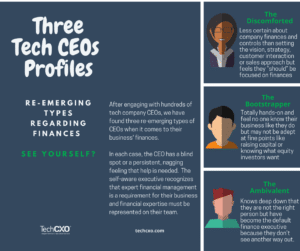
Three Profiles of Tech CEOs

In technology, three CEO profiles continually present themselves when it comes to the handling of finances.   In each case, the CEO has a blind spot or a persistent, nagging feeling that help is needed.  The self-aware executive recognizes that with rapidly changing business models and dynamics, expert financial management is a requirement for their business and financial expertise must be represented on their team.  However, their hesitancy continues.

Do any of these sound like you?

  • The Discomforted – This executive is less certain about company finances and controls than setting the vision, strategy, customer interaction or sales approach but feels they “should” be focused on finances.
  • The Bootstrapper  – Many founders who have created their businesses are totally hands-on and feel no one know their business like they do. These executives are rarely adept at the fine points, such as finding new sources of capital or know what equity investors want.
  • The Ambivalent – This CEO knows deep down that they are not the right person to be overseeing finances but “doesn’t know what they don’t know” and therefore have become the default finance executive because they don’t see another way out.

View the Infographic Now (PDF)

Tech CEO

Tech CEO Profiles Re: Finances

Increasingly, CEOs are outsourcing the finance function on a project, part-time or interim basis to an experienced CFO who often brings highly specialized skills to his/ her assignment. Depending on the circumstances, it may be more efficient and cost-effective to bring in a hired gun.

This approach affords CEOs the flexibility to bring someone on without incurring significant overhead.  Consulting contracts usually have very short termination periods and help avoid recruiter fees,  too.  Thus, CEOs can tap their network to not only find someone quickly and cost-effectively, but they may even be able to find someone with highly specialized skills to help solve their current issues.

To learn more about how to make these part-time and interim arrangements successful, click on the book image to download a free eBook on: The Outsourced CFO: A CEO’s Selection Criteria.


Why Most Acquisitions Fail (and How to Get Integration Right) Part 1

The Overlooked Key to M&A Success: Integration Leadership

Companies seek to accelerate revenue growth or enter new markets through mergers and acquisitions. They spend a lot of energy and resources identifying the right targets based on synergy and combined financial models.

But oftentimes, the real value of the acquisition is not realized. M&A typically fails during integration. All that effort and capital spent on acquiring the target is wasted.

Why? There can be several reasons:

1. Unless you are a large company that can afford their own in-house acquisition integration department, companies simply don’t have the internal resources to assign to an acquisition integration to do it right.
2. The existing management team fears creating a costly disruption in the acquired target.
3. The integration burden is placed on existing managers who already have a day job causing endless delay and lack of initiative.
4. The talent in the acquired firm is ignored and “stars” exit early, quickly causing a critical talent drain and loss of business know-how.

Every acquisition integration requires a dedicated, objective leader to achieve a timely and cost effective successful outcome. The leader must have the business acumen and soft skills to execute on the complex business objectives and strategy without negatively disrupting the combined organizations and their customers. It’s a careful balancing act that is learned from years of extensive experience.

TechCXO has on-demand executives that can lead your next acquisition integration.

The emphasis is on leader. An executive that can readily step-in, manage the various functions, communicate with the C-Suite, Board and management teams with confidence and execute.

The benefits of an interim executive to lead the integration are manifold:

1. The interim executive is not connected to either company’s political structure. He/she can speak freely, impartially and objectively about the problems. He/she will include and listen to the right functional leads on both sides. He/she will build needed relationships and trust on all sides to accelerate the integration.
2. The interim executive brings experience and best practices of completing acquisitions for other companies. For most clients, an acquisition happens every five years or longer and the internal talent lacks enough experience.
3. The interim executive has the experience to distinguish the real problems from the “noise.” Every acquisition or merger generates a tremendous amount of what I call “noise”: It’s all the supposed problems identified by employees in all functions at all levels of why the integration is going to fail. Most of it is rooted in cultural differences, feelings of resistance, lack of vision, fear of being excluded, organizational misalignment, geographic separation, to name a few. The experienced acquisition leader will collect all of the noise and identify the real problems in an atmosphere of inclusion and trust. Each acquisition is different and the real problems can exist anywhere inside the noise. The acquisition leader will engage and communicate with the organization to be effective in every situation.
4. The interim executive will also ensure that the customer experience is not negatively impacted. This is not easy, as you will have disparate sales, customer service, ERP systems, order management protocols and supply chains. Customers are always weary of mergers and acquisitions, but the consensus is that the customer experience never improves. You do not want to lose market share.
5. The interim acquisition leader will establish a timeline with hard milestones and report progress to a Steering Committee of carefully selected stakeholders (C-Suite, Board Members, Investors as appropriate). He/she will make sure that communication occurs at the right intervals and in real time. The acquisition executive will level-set the integration objectives up front: What do we want this integrated company to look like? An assimilation? A hybrid of best practices? A cost optimization play? The acquisition executive can advise the leadership on these decisions and develop the integration plan and timeline accordingly.
6. The interim executive has the ability to shape the integration around the complex acquisition objectives that drove the merger in the first place. Sometimes these objectives are highly sensitive in nature and should not be shared with internal managers (i.e, divestiture, cost reduction, geographic consolidation, liquidation of assets)
7. The interim executive will lead the teams and reduce the “human toil” and accelerate the average acquisition experience. The leadership is accomplished through influence or cross-functional reporting structures as appropriate. Every company culture is different.

The four important areas that a seasoned acquisition integration leader manages are:

1. Customer experience (communication, order management)
2. Creation of a joint sales force
3. Proper cadence of system integration (email, ERP, portals, platforms)
4. Managing the temperament of the leadership (CEO, CFO, Board, Owners, Investors) on all sides for the benefit of a successful, timely integration. This is where executive soft skills are crucial. The soft skills, the executive’s ability to lead organizational change and influence, are equally important, if not more important, than the hard skills.

One more note: Timing is critical. A successful integration requires preparation and a strong “Day One” execution. The integration executive should be brought in at least two weeks before the closing to prepare the organization for a successful kick-off.

Before Mounting the Synergy Unicorn: New Skills for Merged Management Teams

Companies seek to accelerate revenue growth or enter new markets through mergers and acquisitions. A great deal of excitement and justification surrounds the projected synergies and combined financial models.

Synergy: 1+1>2

Or is it?

However, as we all know, few companies realize the true value of the acquisition synergies. When M&A fails, it fails during integration. Much of the effort and capital spent on acquiring the target is sub-optimized or in many cases wasted.

In this piece, I’ll briefly cover what dynamics occur among the senior leadership team that erode synergistic value. And, I’ll discuss the two skill sets that the leaders of the combined entity must have to mitigate value leakage.

[The article was adapted from Matt Oess‘s original blog post]

However, as we all know, few companies realize the true value of the acquisition synergies. When M&A fails, it fails during integration. Much of the effort and capital spent on acquiring the target is sub-optimized or in many cases wasted.

In this piece, I’ll briefly cover what dynamics occur among the senior leadership team that erode synergistic value. And, I’ll discuss the two skill sets that the leaders of the combined entity must have to mitigate value leakage.

WHY M&A FAILS

A major failure mode of integration happens when the two leadership teams from the companies come together. The company’s executives create a detrimental amount of dysfunction when they unknowingly engage in the following:

  1. Jockey for position – Who’s going to sit in what seat when the final org chart has been created? Even the most objective leader can’t help but worry about what role they and their close peers will play in the future state of the company.  Even when the CEO of the merged entity tries to paint a clear picture of his or her future organization, the senior staff knows that “the changes are never over” and “I have to look out for myself or I’ll end up with the short end of the stick”. The human mind is amazingly good at painting worst-case imagery of “what if I don’t get the role I want?”. This drives behavior that destroys alignment among leaders and marginalizes the intended synergies.
  2. Protect my people – Executives can’t help but have a bias for and a comfort with those that have helped them to be successful in the past. As humans, we are also protectors of those we are closest to. And, we want what’s “best for our team”. This dynamic precludes objectivity when assembling the best possible team to lead the resulting company and limits optimal outcomes.
  3. Bias toward “what got us here” – No integration meeting would be complete without several incantations of “That’s not how wedid it in the past” or “We’ve tried that before, and it didn’t work”. Fear is an incredibly powerful force that creates enormous risk and dire outcomes in the minds of the two leadership teams. These barely-detectable fears paralyze good ideas that should be implemented, but don’t. As importantly, these behaviors almost always ensure that the teams can not fully align. And, that dynamic destroys synergy.

Here’s the thing. I truly believe that people show up to do their very best and do so with the very best intentions. And, the leaders who exhibit the above  behaviors do so, unknowingly. The brain’s protection mechanisms kick in to protect our own best interests. It’s perfectly natural for the brain to create the fear-based stories in our subconscious that drive undesirable behavior. And, this is where the change management aspects of the integration erode tremendous value.

So, imagine what the combined executive team looks like, as a unit, from the stakeholder’s purview. Each executive is trying their best and is well intentioned. But, the brain’s protection mechanisms drives the actions of the individuals that combine to create a team that typifies mis-alignment, dysfunctional communication, and poor collaboration.

Before putting in motion all the strategies, goals, org charts, and tactical action plans necessary to realize true potential of a merger, something more important must take place. The two management teams must know about the attitudes and behaviors they are about to engage in. And, they must develop the emotional intelligence skills and support each other to navigate these tough waters.

NOW WHAT?

The first step is to take the unconscious actions and behaviors of these executives…and make them conscious.  

To that end, the first skill set that we must impart to the executives is self-awareness of the mechanisms in our brains that create the behaviors that will destroy the very stakeholder value that they wish to enhance. Left undetected, the executives will navigate through their natural gut feel, which creates the appearance of false truths and leads to dysfunction.

Second, we help the executives build and leverage the necessary observation and communication skills required to create desirable outcomes and support each other. By creating intentionality and dramatically increasing the true situational awareness skills of the individual executives, we drastically increase the combined team’s emotional intelligence (as a collective leadership unit). And, we add a new dimension to their leadership skill set.

This isn’t a one-and-done training. We plan during the M&A due diligence phase. We launch on day zero. And, we support every senior executive until integration is complete and we achieve the synergies. Only through this intentionality and constant focus can newly-formed companies avoid the pitfalls mentioned above.

TAMING THE UNICORN

Merger and Acquisition teams, CEOs, CFOs, and Board Members that are considering buy/sell/merge activity have the power to mitigate the risks and deliver the allusive synergistic value. Strategy and actions are necessary, but not sufficient. Call it an insurance policy. Call it intentionality. It’s a simple formula…

Synergy:

1 + 1 + Team Emotional Intelligence > 2

Every M&A deal needs a program to mitigate these risks. The earlier these skills and competencies are enabled across the entire executive team, the faster the M&A teams mitigate the integration and change management risks. The broader and deeper these competencies are driven, the faster M&A teams create the alignment, collaboration, and communication required to deliver the synergies of the acquisition.

  • « Previous Page
  • 1
  • 2
  • 3
TechCXO Logo-Reversed
About TechCXO

People
Clients
Contact & Locations
News

Executive Focus

Finance
Revenue Growth
Product & Technology
Human Capital
Executive Ops

Newsletter

TechCXO HQ

3423 Piedmont Rd., NE
Atlanta, GA 30305

LinkedIn Facebook X

Copyright 2026 TechCXO
Privacy Policy | Accessibility